In 1852, the French engineer, Henri Giffard, flew seventeen miles in the first powered airship. For the next fifty years other powered airships flew but each with the same limitation: size. This restriction was because non-rigid airships (or blimps) maintain their shape through the pressure of the gases within the envelope. Towards the end of the century various engineers began to work on designs for rigid airships, which could be much larger and have a far greater range. Foremost among these visionaries was the German Count, Ferdinand von Zeppelin.
In 1899, von Zeppelin started to manufacture a rigid airship based on the design of David Schwarz, a Croatian wood merchant. The design was used by the German entrepreneur Carl Berg to procure a contract to build an airship for the Prussian Government. After Schwarz died in 1897, Berg teamed up with von Zeppelin, who had seen the potential in rigid airships during the 1870s and could raise the capital required to fund the venture, and the German designer Theodor Kober who completed the design. Berg, von Zeppelin and a third investor, formed the Gesellschaft zur Förderung der Luftschiffart (Society for the Promotion of Airships).
At a little after 8pm on 2nd July 1900, the Zeppelin LZ1 left its floating hanger on Lake Constance in southern Germany, and took to the skies: the first successful untethered rigid airship flight. The LZ1 was made from aluminium (supplied by Berg) covered in cotton cloth. It was over 400 feet long, nearly 40 feet wide, and was powered by two 15-horsepower Daimler internal combustion engines, which each turned a pair of propellers. The flight lasted seventeen minutes in which time the five passengers travelled 3.7 miles reaching a maximum altitude of 1,300 feet before landing back on the Lake
In spite of problems with the design and mechanics the LZ1 flew twice more before being scrapped. Nevertheless, the Society attracted no further investment and the three partners liquidated it. Undaunted, von Zeppelin continued to develop airships financed from his own pocket, as well as a lottery and private donations - which, somewhat perversely, flooded in following a well publicised crash landing of one of his airships. Within ten years of the first flight of the LZ1, his company was producing commercial airships, which were so popular that they became synonymous with him.
Related posts
Montgolfier Brothers first public balloon flight: 4th June 1783
Balloonmania reached the United States: 9th January 1793
2 July 2012
On this day in history: First Zeppelin flight, 1900


24 June 2012
On this day in history: Münster Rebellion ended,1535
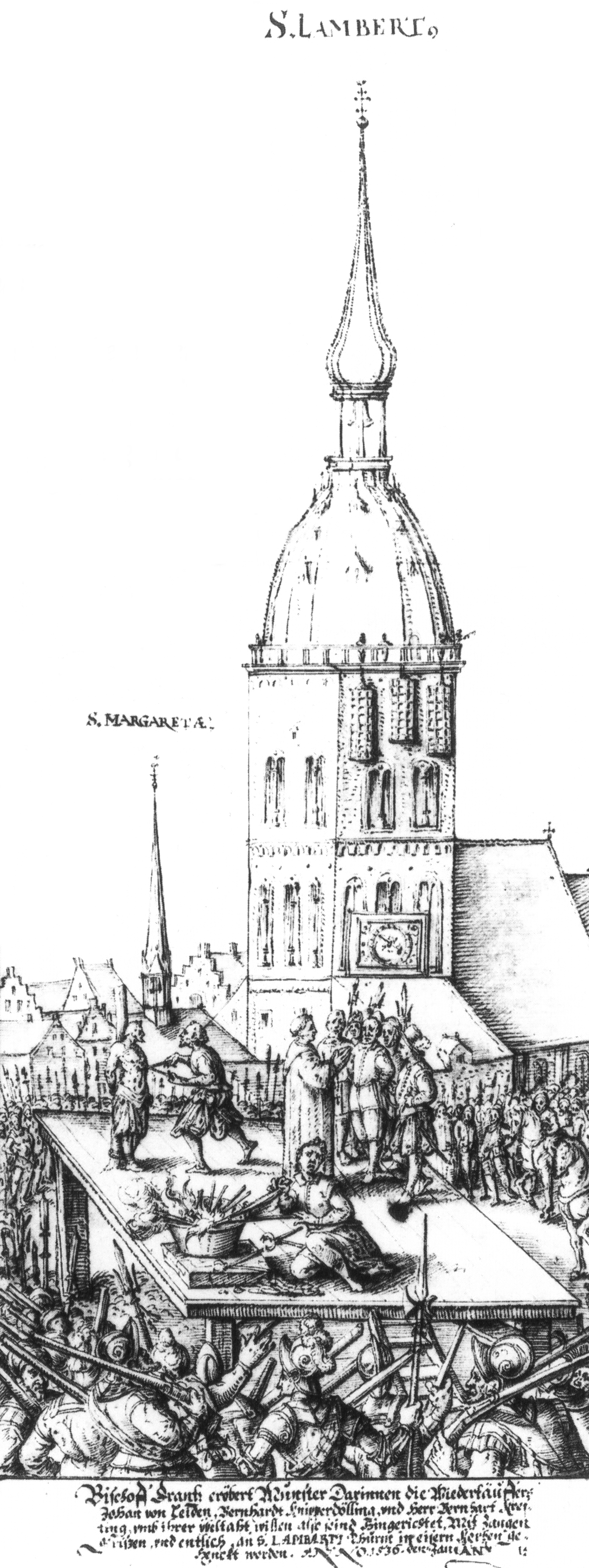 In the sixteenth century a number of increasingly vocal critics of the practices and beliefs of the Catholic church emerged. These criticisms, taken as a whole, became known as the Protestant Reformation, the effects of which were felt across Europe as new churches emerged. Switzerland, in particular, was a hotbed of religious reform being birthplace of Calvinism and the Anabaptist faith, although some historians maintain that the latter also had roots in Holland and the Rhineland.
The Anabaptists were so called because they deferred baptism until somebody is old enough to chose to enter the faith. Not only did Anabaptists want religious reform but also formed a social reform movement, which became increasingly radicalised during the Peasants' War, a series of popular revolts that flared up across the Holy Roman Empire in 1524 and 1525. The princes and bishops restored order, re-established the status quo, and in some places, they made conditions even harsher for the common people, many of whom were radicalised and so became Anabaptists.
One place where the seeds of radical religious and social reform took root was the German of Münster. Ruled by a bishop, Franz von Waldeck, and council of guild leaders, the citizens looked to religious leaders to bring about social change. The Anabaptist pastor Bernhard Rothmann declared that a new prophet would soon arrive to liberate the people of the city. This 'prophet' was a Dutch baker called Jan Matthys, who along with Rothmann and Jan Bockelson, a tailor from Leyden, whipped up such religious sentiment within the populace that in February 1534 they managed to drive the council and bishop from the city and install their own mayor, Bernhard Knipperdolling, a guild leader and Anabaptist convert.
In Easter of that year, Matthys set out to conquer the rest of the world believing that the Day of Judgement was at hand, but he and his thirty followers died at the hands of the bishop's besieging army. Bockleson took over as religious and political leader and instituted a number of social reforms including the legalisation of polygamy and instituting the community of goods. He claimed to be a descendent of King David and as such was the absolute ruler of the new 'Zion'.
Nevertheless, this new 'Zion' was not to last. On the night of 24th June 1535, the bishop's forces finally gained entry to the city using information gained from Heinrich Gresbeck, who had been a guard on the city walls and was captured while trying to flee. The bishops forces quickly took the city, capturing the Anabaptist leaders and killing almost all of the male population. Bockelson and Knipperdolling were tortured and eventually executed in January 1536, their mutilated bodies were displayed in cages hung from the steeple of St. Lambert's Church, which are still there today.
The Global Anabaptist Mennonite Encyclopaedia Online has a more detailed account of the Münster Anabaptists.
Related posts
Duel of the Mignons: 27th April 1578
The Solemn League and Covenant: 25th September 1643
Louis XIV revokes the Edict of Nantes: 22nd October 1685
18 May 2012
On this day in history: Frankfurt Parliament convened, 1848
 1848 was a year of revolutions: the Sicilian Revolution of Independence from the Bourbon monarchy; elsewhere in Italy - the Roman and Venetian republics; the Hungarian Revolution against Hapsburg rule; the Polish uprising against Prussian rule; the Revolution against the July Monarchy in France; the Romanian uprising in Wallachia; the Praieira revolt against the Brazilian Empire; and the March Revolution in various German lands.
The March Revolution of 1848 was a liberal revolution within the German Confederation, which was the loose federation of thirty-eight states created by the Congress of Vienna in 1815. In the south and west of the country a rise of nationalist sentiment and demands for liberal reform crystallised in mass demonstrations and the formation of popular assemblies. A group of these reformers from across Germany met in Heidelberg, in the state of Baden, on 5th March to plan elections for a German national assembly. Later that month liberal reformers met up in a 'Preparliament' in St. Paul's church in Frankfurt to formulate guidelines for the first ever national elections in Germany with the blessing of the leaders of the various states of the Confederation
The states held elections in late April through to early May that year (with some variation in suffrage between states, due to the vague requirement that the voters be 'independent' male adults). Then, on 18th May 1848, around eight-hundred delegates to the Frankfurt Parliament convened their first session. So many of the delegates were professors, teachers or at least university graduates that the assembly became known as the Professorenparlament ('Professors Parliament'). The delegates then embarked on the process of writing a constitution for a unified German nation.
Over the next year, problems dogged this process of nation building: a lack of a national bureaucracy and military; weak leadership; a resurgent aristocracy; and a lack of support from Prussia (arguably the most powerful state in Germany). This last problem effectively ended the dreams of the parliamentarians when Prussia's King, Frederick William IV, refused the title of Emperor of Germany in 1849. The ensuing constitutional crisis resulted in the majority of states recalling their delegates from the Parliament, the rump of which reconvened in Stuttgart and was finally dispersed by troops and police on 18th June 1849, bringing an end to the dream of a German unification.
Related posts
Holy Roman Empire ended: 6th August 1806
German Reunification: 3rd October 1990
24 April 2012
On this day in history: West German embassy siege in Stockholm, 1975
 On the 24th April 1975, members of a group of armed revolutionary group from Germany known as the Red Army Faction entered the West German embassy in Stockholm, Sweden. They took the embassy staff hostage in the hope that they could negotiate the release of their fellow revolutionaries held in German prisons. These prisoners included Andreas Baader and Ulrike Meinhof, whose names were used by the media referring to the group as the Baader-Meinhof Gang as opposed to the Red Army Faction.
Whatever they were called, the group of self styled urban guerrillas had formed in the early 1970s after Meinhof and three others had helped Baader escape custody from a library in a research institution where he had been allowed to study, without handcuffs. Baader was serving a sentence for involvement in two fire bombings in response to the clampdown on radical student activities in West Germany. The group followed an extreme form of Marxist-Leninist ideology, which they saw as justification for their campaign of political assassinations that they funded by robbing banks. Needless to say, the West German government saw them as terrorists, not only for their actions but for their links to Palestinian groups such as Fatah and Black September.
The West German police captured several members of the RAF in June and July 1972. There was no further action by the Faction until the embassy siege three years later carried out by members of a radical anti-psychiatric group who had allied themselves with the RAF. The six hostage-takers - Hanna-Elise Krabbe, Karl-Heinz Dellwo, LutzTaufer, Bernhard Rössner, Ulrich Wessel and Siegfried Hausner - killed one hostage, the Military Attache, Baron von Mirbach when the Swedish police did not withdraw when the group demanded it. The German Chancellor, Helmut Schmidt, refused to negotiate with terrorists, and in response the RAF shot another hostage: an economic attaché called Hillegaart.
As the Swedish police stormed the embassy the explosives, with which the hostage-takers had rigged the building, accidentally ignited. The RAF members and the remaining hostages were all injured in the blast with Siegfried Hausner dying from his wounds. Nevertheless, this was far from the end of the RAF. In 1977, West Germany was rocked by a campaign of assassinations, which became known as the 'German Autumn'. Yet, following the apparent suicides of the principle activists in the RAF during 1976 and 1977, the group became less active until they finally called off their campaign in April 1992.
To learn more about the RAF see (the somewhat sympathetic article) 'A Brief History of the Red Army Fraction' on the World History Archives web site. Alternatively you can read the 'Who were the Baader-Meinhof gang?' article on the BBC web site.
Related posts
Wall Street Bombing: 16th September 1920
U.S. consulate in Quebec City bombed: 24th May 1968
29 January 2012
On this day in history: First gasoline powered automobile patented, 1886
 The German engine designer and automobile engineer Karl Benz was born on 25th November 1844 in Karlsruhe, Baden, to Josephine Vaillant. A few months after he was born, his mother married his father, a locomotive driver named Johann George Benz, who died in a railway accident when Karl was only two years old. The death left the family in financial difficulty, but Josephine managed to provide her son with a quality education.
Karl was an excellent student, attending the local grammar school and technical college before gaining a place at the city's university to study mechanical engineering at the age of fifteen. He graduated in 1864 at the age of nineteen and spent the next seven years moving between jobs where he received professional training. In 1871 Benz opened a mechanical workshop in Mannheim with August Ritter.
Ritter turned out to be a liability. The business only survived when Benz's fiancée, Bertha Ringer, used her dowry to buy Ritter's shares. The business continued to struggle financially, so from 1878 Benz started working on patenting various innovations in engine design, including the two stroke engine, an ignition system using sparks from a battery, spark plugs, the carburettor, the clutch, the gear shift, and the water radiator. Nevertheless, the high production costs of Benz's Gas Factory resulted in the local banks demanding that his business become incorporated.
The creation of the joint-stock company Gasmotoren Fabrik Mannheim in 1882 left Benz with only five per cent of the shares in the business. He also became marginalised when it came to designing new products. Dissatisfied, a year later he left the company that he had built to enter into a partnership with the owners of a bicycle repair business, Max Rose and Friedrich Wilhelm Eßlinger.
The company called Benz & Company Rheinische Gasmotoren-Fabrik produced a successful range of industrial machines and quickly expanded. The success of the business enabled Benz to start developing his ideas for a horseless carriage that he had been considering since his youth. In 1885 he produced the Benz Patent Motorwagen. A three wheeled vehicle powered by a 0.8hp four-stroke engine with a top speed of 16 km/h (10 mph).
On 29th January 1886, Benz patented his Motorwagen. Over the next few years Benz tested his design on public roads, refined his design and produced two more models of his Motorwagen, which he made available for sale to the public. In 1888 he made his first sales, including one to the Paris-based bicycle manufacturer Emile Roger. Roger had previously produced Benz's engines under license, now he also started manufacturing the automobiles and selling them to Parisians.
Benz continued to produce innovative designs of motor vehicles. In 1894 he produced the Velo, which many regard as the first production automobile and a year later he designed the first truck. He died in 1929 at the age of eighty-four as one of the key figures in the development of the automobile industry.
A facsimile of Benz's 1886 German patent No. 37435 is available to download in pdf format.
Related posts
First Volvo car produced: 14th April 1927
First man to drive an automobile at over 300 mph: 3rd September 1935
First Formula One Championship race: 13th May 1950
7 December 2011
On this day in history: First German steam-hauled railway opened, 1835
 The development of public railways in Britain attracted interest from the rest of Europe. King Ludwig of Bavaria sent the engineer Joseph von Baader to England to evaluate the new method of transport. In spite of Baader's favourable report, the Bavarian government's initial interest in railway development came to nothing, but years later a group of businesspeople formed a committee to consider the construction of a railway between Nuremberg and Fürth.
On 14th May 1833, they founded the Gesellschaft zur Errichtung einer Eisenbahn mit Dampffahrt zwischen Nürnberg und Fürth ("Company for the Establishment of a Steam Railway between Nuremberg and Fürth"). The major shareholder in the company was the merchant George Zacharias Platner, who contributed 21,000 of the planned 132,000 guilder capital and became the company's first director. The king authorised the use of his name by the railway company, from which his government purchased a token two shares.
The king also permitted the road builder Paul Camille von Denis to manage the construction of the railway, which Denis decided would use the English gauge. The company also looked to England for its first locomotive because no German company was then capable of the undertaking. They purchased a 2-2-2 steam locomotive called Adler ("Eagle") from Robert and George Stephenson of Newcastle for 13,000 guilders.
On 7th December 1835, Adler hauled the first train along the 7.45 km Ludwigsbahn, driven by the Englishman, William Wilson. The high cost of importing coal from Saxony meant that only two of the hourly passenger services were steam-hauled, with the remainder drawn by horses. The company purchased another Stephenson locomotive, Pfeil ("Arrow"), followed by a series of German-built locomotives before finally withdrawing horse-drawn services in 1863.
Related posts
The world`s first public railway opened: 27th September 1825
Tom Thumb beat a horse: 28th August 1830
Queen Victoria`s first train journey: 13th June 1842
First underground railway opened: 10th January 1863
Steam locomotive world speed record: 3rd July 1938
Last steam-hauled mainline passenger train on British Railways: 11th August 1968
5 December 2011
On this day in history: Battle of Leuthen, 1757
 In 1740, the newly crowned King Frederick II of Prussia annexed the prosperous Austrian province of Silesia. He wanted to connect his own disparate lands in Silesia and also prevent other European rulers doing the same. Frederick found his pretext for the invasion in an obscure 1537 treaty by which his dynasty should have inherited a number of Silesian princedoms.
The ensuing conflict, known as the First Silesian War, formed part of the larger War of the Austrian Succession, during which the French and Prussians challenged the power of Hapsburg empire. The Second Silesian War also formed part of this larger conflict, during which the Austrians failed to reclaim the province. The war ended with the signing of the 1745 Treaty of Dresden, by which the Austrian ruler, Maria Theresa, recognised Prussian rule in Silesia, in return for Frederick's recognition of her husband as Holy Roman Emperor.
In 1756 the European powers took up arms once more in the Seven Years' War with the Austrians and Prussians again in opposing camps. Fearing that the Austrians would make another attempt to retake Silesia, Frederick led a pre-emptive strike against Austria's Saxon allies. While he campaigned in Saxony, the Austrian forces managed to capture much of Silesia; so, following the defeat of French and Austrian forces at Rossbach, Frederick turned his attention to retaking Silesia.
On 5th December 1757, Frederick's army found an Austrian force twice its size near the village of Leuthen (now Lutynia, Poland). Frederick marched his troops towards the larger army before ordering his cavalry to make a diversionary assault on a nearby village before forming up to face the Austrian right flank. He then marched his infantry to the south behind a line of hills.
The Austrian commander, Prince Charles of Lorraine, had deployed his men in very long lines, knowing that the flanking attack was Frederick's favourite tactic. When he saw the Prussian cavalry face his right flank, he suspected that they were about to act as the spearhead of just such an offensive move; consequently, he sent his reserve and his cavalry to strengthen his right. Then, when he saw the Prussian infantry marching, Charles assumed them to be retreating.
Rather than retreating, Frederick marched his men round to engage the Austrian left flank, which crumbled. Charles tried to reform his troops, but the length of his lines meant that this was a slow process. Nevertheless, The Austrian cavalry saw an opportunity to outflank Frederick, but they were intercepted by the Prussian cavalry and the ensuing melee careered into the back of the Austrian lines, which broke.
Frederick's army of approximately 36,000 men and 167 guns defeated an Austrian force of around 80,000 men armed with 210 cannon. The Prussians lost 1,141 men with 5,118 wounded, compared to over 3,000 Austrian fatalities and around 7,000 wounded. The Prussians captured something in the order of 12,000 Austrians, while the rest of Charles' army fled to join the Austrian withdrawal from Silesia.
Related posts
Battle of Culloden: 16th April 1746
Treaty of Paris signed: 10th February 1763
Holy Roman Empire ended: 6th August 1806
27 November 2011
On this day in history: Première of Strauss' Also sprach Zarathustra, 1896
 Richard Strauss was born in June 1864 in Munich, where his father, Franz, was the principal horn player at the Court Opera. Richard received a musical education from his father and started writing music at the age of six; yet, when he entered the city's university he chose to study philosophy and art history, rather than music. He spent a year at Munich University before moving to Berlin where he briefly studied music before securing a post as an assistant conductor in Meiningen, becoming principle conductor in 1885.
It was around that time that Strauss began composing tone poems, including Don Juan, op.20 (1889) and Tod und Verklärung ("Death and Transfiguration"), Op. 24 (1888-9). In 1894 he started sketching ideas for a tone poem inspired by Friedrich Nietzsche's philosophical novel Also sprach Zarathustra ("Thus Spoke Zarathustra"), finishing the piece on 24th August 1896. It lasts around thirty minutes, comprising an introduction - now best known as the theme to Stanley Kubrick's 1968 film, 2001: A Space Odyssey - and eight other sections named after chapters in Nietzsche's book.
On November 27th 1896, Richard Strauss conducted the première of Also sprach Zarathustra, Op. 30 in Frankfurt. The piece proved popular, soon entering the classical repertoire. Nevertheless, some criticised Strauss' attempt at composing philosophical music, but he responded saying that he was setting philosophy to music, rather that his symphonic poem was an homage to Nietzsche's genius and an expression of the impact that the book had upon him.
Related posts
First performance of Das Rheingold: 22nd September 1869
Riot at première of Stravinsky`s Rite of Spring: 29th May 1913
14 November 2011
On this day in history: Philosopher G.W.F. Hegel died, 1831
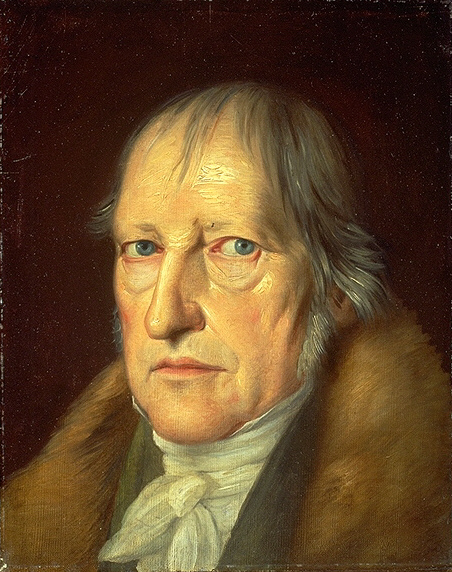 Georg Wilhelm Friedrich Hegel was born on 27th August 1770 in Stuttgart, which was then part of the Duchy of Württemberg where his father served as a revenue officer. Hegel learnt Latin from his mother at a young age and later attended the Stuttgart Gymnasium. At his father's suggestion he embarked on a career as a protestant clergyman, enrolling at the University of Tübingen seminary in 1788.
On completing his studies in 1793, Hegel decided not to become a man of the cloth and started work as a private tutor in Berne, Switzerland. He had developed an deep interest in philosophy and began to study the works of Immanuel Kant and Johann Fichte. Nevertheless, he had not abandoned his study of religion as demonstrated by his writings of that time: Life of Jesus and The Positivity of Christian Religion.
In 1796, Hegel co-wrote The First Programme for a System of German Idealism with his friend the philosopher Friedrich Wilhelm Joseph von Schelling. The next year he left for Frankfurt to take up a new tutoring job, but the bequest he then received following his father's death enabled him to return to education. In 1801, he found an non-salaried position at the University of Jena where he continued his studies, wrote and lectured.
Having exhausted the legacy from his father, in 1807, Hegel moved to Bamberg to take the position of editor of the Bamberger Zeitung newspaper. A year later he received the appointment of headmaster at a Gymnasium in Nuremberg. By this time he had published his first solo philosophical work, Phänomenologie des Geistes ("Phenomenology of Mind"), in which he detailed his dialectic method.
While teaching in Nuremberg, Hegel published the first part of his Wissenschaft der Logik ("Science of Logic") in 1812. The last part entered print in 1816, the same year that he received various offers of university professorships. He chose to take up the appointment from the University of Heidelberg, but two years later he became the chair of philosophy at the University of Berlin, where he published his Grundlinien der Philosophie des Rechts ("Elements of the Philosophy of Right") in 1821.
In 1830, the sixty-year-old Hegel became rector of the university and during the following year King Frederick William III of Prussia decorated him in recognition of his services to the state. Later that same year Hegel left Berlin during a cholera epidemic. Nevertheless, he died in his lodgings in Kreuzberg on 14th November 1831.
The German texts of a number of Hegel's works are available on Project Gutenberg. To learn more about Hegel's thought see his entry on the Stanford Encyclopaedia of Philosophy site.
Related posts
First doctorate conferred on a woman: 25th June 1678
Denis Diderot died: 31st July 1784
3 October 2011
On this day in history: German Reunification, 1990
 Following their defeat of Germany in 1945, the Allied Powers occupied different parts of the country that remained after they granted a number of eastern German provinces to Poland. The French occupied the south-west, the British occupied the north-west, the United States took control in the south, and the Soviet Union controlled the east. They also divided the city of Berlin into different occupied zones, although it was surrounded by the Russian zone.
At the Potsdam Conference, the Allies agreed that Germany should remain a single economic entity albeit one with decentralised political power. As tensions increased between the U.S.A. and the U.S.S.R these plans failed to materialise. In 1948 the Russians announced that they would no longer take part in the quadripartite administration of Germany and halted road access to the French, British and American sectors of West Berlin meaning that any supplies had to be brought into these areas by air.
In May 1949, the American, British and French unified the zones they occupied to create the Federal Republic of Germany (Bundesrepublik Deutschland - BRD), and five months later the Soviets followed suit creating the German Democratic Republic (Deutsche Demokratische Republik - DDR). In 1961 the East Germans constructed a wall around West Berlin to prevent their citizens crossing into the West. Over the following decades relations improved between the two Germanies as reform movements appeared in the Eastern Bloc.
The results of 1989 local elections in the DDR led to widespread protests and a dramatic increase in requests for exit visas. When the Hungarian relaxed their border controls there was a flood of emigration from East Germany to the BRD. Rather than employ the repressive measures of earlier times, the government in the DDR started planning a peaceful transition from socialism to capitalism and the from communist party dominance to free elections.
In November 1989 the Politburo of the DDR announced the opening of border checkpoints in the Berlin Wall. The following March the East German people voted in democratic elections, effectively ending communist rule in their country and opening the way for German reuinification. That summer, negotiations took place between the two German governments and those of the four occupying powers resulting in The Treaty on the Final Settlement with Respect to Germany, signed in Moscow in September.
On 3rd October 1990, the five re-established federal states of the former DDR and the new city-state of Berlin joined the Federal Republic of Germany. The involved parties had rejected the alternative option of writing a new constitution to create a new German state, rather the constitution of West Germany had been amended to permit Berlin, Brandenburg, Mecklenburg-Vorpommern, Saxony, Saxony-Anhalt, and Thuringia to join. The anniversary of the re-unification is celebrated every year as the Day of German Unity (Tag der deutschen Einheit), a national public holiday.
The full text of The Treaty on the Final Settlement with Respect to Germany is available on the U.S. Diplomatic Mission to Germany's web site.
Related posts
Holy Roman Empire ended: 6th August 1806
Frankfurt Parliament convened: 18th May 1848
The Brezhnev Doctrine: 13th November 1968
22 September 2011
On this day in history: First performance of Das Rheingold, 1869
 On 22nd September 1869, the National Theatre in Munich hosted the première performance of Das Rheingold ('The Rhine Gold'), the first part of Richard Wagner's four-part opera Der Ring des Nibelungen ('The Ring of the Nibelung'). Wagner had wanted the whole cycle to be performed together in new opera house specifically designed for that purpose; however, at the insistence of his patron, King Ludwig II of Bavaria, preview performances were given of the first two parts - the second being Die Walküre ('The Valkyrie'). Wagner began work on the opera in the summer of 1848 when he wrote a basic outline of a story based loosely on the myths of the Norse gods.
In Das Rheingold, a dwarf called Alberich who steals the Rhinegold from which he makes a magic ring that would enable its wearer to rule the world. The god Wotan wants the ring for himself, and on the advice of his fellow god, the cunning Loge, the two travel to the dwarven mines to steal the ring. Loge tricks Alberich into using a magic helmet to transform himself into a toad, whereupon the gods capture him and take him to the surface. In return for his freedom the gods demand that Alberich hand over all his treasure, including the ring, which the dwarf reluctantly does but not before cursing the ring to bring its wearer nothing by unhappiness.
At the première August Kindermann played Wotan, Heinrich Vogl played Loge, and Wilhelm Fischer appeared as Alberich. The whole cycle was not performed together until August 1876 when it was staged at the Bayreuth Festspielhaus ('Bayreuth Festival Theatre').
Kristian Evensen's Richard Wagner Website includes a more complete synopsis of Das Rheingold as well as the other parts of Der Ring des Nibelungen.
Related posts
Première of Strauss' Also sprach Zarathustra: 27th November 1896
Riot at première of Stravinsky`s Rite of Spring: 29th May 1913
14 August 2011
On this day in history: Cologne Cathedral completed, 1880
 In 1164, Cologne's Archbishop Rainald von Dassel brought the relics of the Magi to the city after the Holy Roman Emperor, Frederick Barbarossa, took them from Milan. These relics attracted pilgrims from across Europe to the city's old Carolingian cathedral necessitating the construction of a new cathedral. On 15th August 1248, Archbishop Konrad von Hochstaden laid the first stone of the construction on the site of the old cathedral.
In 1322, the eastern arm was completed and consecrated. In order that the building could be used, a temporary wall was built while work continued on the rest of the structure. A lack of funds halted this work in 1473, leaving the southern tower incomplete with a huge crane on its top, which became a landmark of the city for the next four centuries.
Intermittent work continued on the nave, but this also ceased during the sixteenth century. In 1794, soldiers of revolutionary France occupied Cologne forcing the archbishop and cathedral chapter to flee. The building became a warehouse for some time, before its reconsecration in 1801.
Finally, in 1842, work recommenced to complete the cathedral after sufficient funds were raised. The Prussian treasury provided half of the money and the Zentral Dombau Verein ('Central Association for Building the Cathedral') raised the remainder. The builders applied modern construction techniques, while adhering to the medieval design.
On 14th August 1880, the last stone was laid, 632 years after construction began. At 10am, the celebrations began when the Prussian flag was unfurled at the top of the north tower and the Imperial standard was raised at the south tower watched by Emperor Wilhelm I. For four years the cathedral was the world's tallest construction, and it continues to present the largest façade of any church in the world.
Related posts
Shri Swaminarayan Mandir inaugurated: 24th February 1822
6 August 2011
On this day in history: Holy Roman Empire ended, 1806
 On 6th August 1806, the Austrian Emperor Francis II gave up the title of Holy Roman Emperor effectively disestablishing a political union founded a millennium earlier by the crowning of Charlemagne. The dissolution of the Empire was one of the terms of the Treaty of Pressburg signed in December 1805 following Austria's defeat by Napoleon's armies at the battles of Ulm and Austerlitz. The other terms of the treaty included Austria's withdrawal from the Third Coalition of nations allied against France, and the loss of Austrian territory across Europe.
Two years earlier, Francis established the Austrian Empire in a response to Napoleon's declaration of the First French Empire. Consequently, he maintained his imperial title as Emperor Francis I of Austria. To fill the political vacuum in Germany caused by the dissolution of the Holy Roman Empire, Napoleon established the Confederation of the Rhine, run by an assembly of German nobles and bishops who allied themselves with France.
The text of the Treaty of Pressburg is available on the Naploeonic Series website.
Related posts
Münster Rebellion ended: 24th June 1535
Principality of Liechtenstein created: 23rd January 1719
Treaty of Paris signed: 10th February 1763
Cisalpine Republic created: 29th June 1797
Frankfurt Parliament convened: 18th May 1848
2 July 2011
On this day in history: First Zeppelin flight, 1900
In 1852, the French engineer, Henri Giffard, flew seventeen miles in the first powered airship. For the next fifty years other powered airships flew but each with the same limitation: size. This restriction was because non-rigid airships (or blimps) maintain their shape through the pressure of the gases within the envelope. Towards the end of the century various engineers began to work on designs for rigid airships, which could be much larger and have a far greater range. Foremost among these visionaries was the German Count, Ferdinand von Zeppelin.
In 1899, von Zeppelin started to manufacture a rigid airship based on the design of David Schwarz, a Croatian wood merchant. The design was used by the German entrepreneur Carl Berg to procure a contract to build an airship for the Prussian Government. After Schwarz died in 1897, Berg teamed up with von Zeppelin, who had seen the potential in rigid airships during the 1870s and could raise the capital required to fund the venture, and the German designer Theodor Kober who completed the design. Berg, von Zeppelin and a third investor, formed the Gesellschaft zur Förderung der Luftschiffart (Society for the Promotion of Airships).
At a little after 8pm on 2nd July 1900, the Zeppelin LZ1 left its floating hanger on Lake Constance in southern Germany, and took to the skies: the first successful untethered rigid airship flight. The LZ1 was made from aluminium (supplied by Berg) covered in cotton cloth. It was over 400 feet long, nearly 40 feet wide, and was powered by two 15-horsepower Daimler internal combustion engines, which each turned a pair of propellers. The flight lasted seventeen minutes in which time the five passengers travelled 3.7 miles reaching a maximum altitude of 1,300 feet before landing back on the Lake
In spite of problems with the design and mechanics the LZ1 flew twice more before being scrapped. Nevertheless, the Society attracted no further investment and the three partners liquidated it. Undaunted, von Zeppelin continued to develop airships financed from his own pocket, as well as a lottery and private donations - which, somewhat perversely, flooded in following a well publicised crash landing of one of his airships. Within ten years of the first flight of the LZ1, his company was producing commercial airships, which were so popular that they became synonymous with him.
Related posts
Montgolfier Brothers first public balloon flight: 4th June 1783
Balloonmania reached the United States: 9th January 1793
24 June 2011
On this day in history: Münster Rebellion ended,1535
In the sixteenth century a number of increasingly vocal critics of the practices and beliefs of the Catholic church emerged. These criticisms, taken as a whole, became known as the Protestant Reformation, the effects of which were felt across Europe as new churches emerged. Switzerland, in particular, was a hotbed of religious reform being birthplace of Calvinism and the Anabaptist faith, although some historians maintain that the latter also had roots in Holland and the Rhineland.
The Anabaptists were so called because they deferred baptism until somebody is old enough to chose to enter the faith. Not only did Anabaptists want religious reform but also formed a social reform movement, which became increasingly radicalised during the Peasants' War, a series of popular revolts that flared up across the Holy Roman Empire in 1524 and 1525. The princes and bishops restored order, re-established the status quo, and in some places, they made conditions even harsher for the common people, many of whom were radicalised and so became Anabaptists.
One place where the seeds of radical religious and social reform took root was the German of Münster. Ruled by a bishop, Franz von Waldeck, and council of guild leaders, the citizens looked to religious leaders to bring about social change. The Anabaptist pastor Bernhard Rothmann declared that a new prophet would soon arrive to liberate the people of the city. This 'prophet' was a Dutch baker called Jan Matthys, who along with Rothmann and Jan Bockelson, a tailor from Leyden, whipped up such religious sentiment within the populace that in February 1534 they managed to drive the council and bishop from the city and install their own mayor, Bernhard Knipperdolling, a guild leader and Anabaptist convert.
In Easter of that year, Matthys set out to conquer the rest of the world believing that the Day of Judgement was at hand, but he and his thirty followers died at the hands of the bishop's besieging army. Bockleson took over as religious and political leader and instituted a number of social reforms including the legalisation of polygamy and instituting the community of goods. He claimed to be a descendent of King David and as such was the absolute ruler of the new 'Zion'.
Nevertheless, this new 'Zion' was not to last. On the night of 24th June 1535, the bishop's forces finally gained entry to the city using information gained from Heinrich Gresbeck, who had been a guard on the city walls and was captured while trying to flee. The bishops forces quickly took the city, capturing the Anabaptist leaders and killing almost all of the male population. Bockelson and Knipperdolling were tortured and eventually executed in January 1536, their mutilated bodies were displayed in cages hung from the steeple of St. Lambert's Church, which are still there today.
The Global Anabaptist Mennonite Encyclopaedia Online has a more detailed account of the Münster Anabaptists.
Related posts
Duel of the Mignons: 27th April 1578
The Solemn League and Covenant: 25th September 1643
Louis XIV revokes the Edict of Nantes: 22nd October 1685
18 May 2011
On this day in history: Frankfurt Parliament convened, 1848
1848 was a year of revolutions: the Sicilian Revolution of Independence from the Bourbon monarchy; elsewhere in Italy - the Roman and Venetian republics; the Hungarian Revolution against Hapsburg rule; the Polish uprising against Prussian rule; the Revolution against the July Monarchy in France; the Romanian uprising in Wallachia; the Praieira revolt against the Brazilian Empire; and the March Revolution in various German lands.
The March Revolution of 1848 was a liberal revolution within the German Confederation, which was the loose federation of thirty-eight states created by the Congress of Vienna in 1815. In the south and west of the country a rise of nationalist sentiment and demands for liberal reform crystallised in mass demonstrations and the formation of popular assemblies. A group of these reformers from across Germany met in Heidelberg, in the state of Baden, on 5th March to plan elections for a German national assembly. Later that month liberal reformers met up in a 'Preparliament' in St. Paul's church in Frankfurt to formulate guidelines for the first ever national elections in Germany with the blessing of the leaders of the various states of the Confederation
The states held elections in late April through to early May that year (with some variation in suffrage between states, due to the vague requirement that the voters be 'independent' male adults). Then, on 18th May 1848, around eight-hundred delegates to the Frankfurt Parliament convened their first session. So many of the delegates were professors, teachers or at least university graduates that the assembly became known as the Professorenparlament ('Professors Parliament'). The delegates then embarked on the process of writing a constitution for a unified German nation.
Over the next year, problems dogged this process of nation building: a lack of a national bureaucracy and military; weak leadership; a resurgent aristocracy; and a lack of support from Prussia (arguably the most powerful state in Germany). This last problem effectively ended the dreams of the parliamentarians when Prussia's King, Frederick William IV, refused the title of Emperor of Germany in 1849. The ensuing constitutional crisis resulted in the majority of states recalling their delegates from the Parliament, the rump of which reconvened in Stuttgart and was finally dispersed by troops and police on 18th June 1849, bringing an end to the dream of a German unification.
Related posts
Holy Roman Empire ended: 6th August 1806
German Reunification: 3rd October 1990
24 April 2011
On this day in history: West German embassy siege in Stockholm, 1975
On the 24th April 1975, members of a group of armed revolutionary group from Germany known as the Red Army Faction entered the West German embassy in Stockholm, Sweden. They took the embassy staff hostage in the hope that they could negotiate the release of their fellow revolutionaries held in German prisons. These prisoners included Andreas Baader and Ulrike Meinhof, whose names were used by the media referring to the group as the Baader-Meinhof Gang as opposed to the Red Army Faction.
Whatever they were called, the group of self styled urban guerrillas had formed in the early 1970s after Meinhof and three others had helped Baader escape custody from a library in a research institution where he had been allowed to study, without handcuffs. Baader was serving a sentence for involvement in two fire bombings in response to the clampdown on radical student activities in West Germany. The group followed an extreme form of Marxist-Leninist ideology, which they saw as justification for their campaign of political assassinations that they funded by robbing banks. Needless to say, the West German government saw them as terrorists, not only for their actions but for their links to Palestinian groups such as Fatah and Black September.
The West German police captured several members of the RAF in June and July 1972. There was no further action by the Faction until the embassy siege three years later carried out by members of a radical anti-psychiatric group who had allied themselves with the RAF. The six hostage-takers - Hanna-Elise Krabbe, Karl-Heinz Dellwo, LutzTaufer, Bernhard Rössner, Ulrich Wessel and Siegfried Hausner - killed one hostage, the Military Attache, Baron von Mirbach when the Swedish police did not withdraw when the group demanded it. The German Chancellor, Helmut Schmidt, refused to negotiate with terrorists, and in response the RAF shot another hostage: an economic attaché called Hillegaart.
As the Swedish police stormed the embassy the explosives, with which the hostage-takers had rigged the building, accidentally ignited. The RAF members and the remaining hostages were all injured in the blast with Siegfried Hausner dying from his wounds. Nevertheless, this was far from the end of the RAF. In 1977, West Germany was rocked by a campaign of assassinations, which became known as the 'German Autumn'. Yet, following the apparent suicides of the principle activists in the RAF during 1976 and 1977, the group became less active until they finally called off their campaign in April 1992.
To learn more about the RAF see (the somewhat sympathetic article) 'A Brief History of the Red Army Fraction' on the World History Archives web site. Alternatively you can read the 'Who were the Baader-Meinhof gang?' article on the BBC web site.
Related posts
Wall Street Bombing: 16th September 1920
U.S. consulate in Quebec City bombed: 24th May 1968
22 February 2011
The Year of Revolution: 1848
 In a break from the 'On this day in history' series, I am taking inspiration from recent events in Tunisia, Egypt, Bahrain and Libya. This year has seen a wave of revolutions in North Africa and Arabia, but it was Europe that rocked with demands for freedom in 1848. While many of these revolutions failed in the short term, they marked a sea change in European politics.
The year 1848 began with the Sicilian Revolution of Independence, which began on 12th January. This was the third popular rebellion against King Ferdinand II seeking the restoration of the liberal constitution of 1812. Negotiations between the monarch and revolutionaries dragged on for eighteen months before the king's forces finally recaptured the island.
The people of other Italian states also rose up against their rulers, notably in the Kingdom of Lombardy–Venetia, then part of the Hapsburg Austrian Empire. The people of Milan and Venice instituted provisional governments, both of which were eventually defeated by the Austrians. These risings, along with the timely constitutional reforms in the Kingdom of Piedmont-Sardinia, laid the foundations for Italian unification.
Nationalist uprisings occurred elsewhere in the Hapsburg Empire. In March, Magyar nationalists forced Emperor Ferdinand to grant them a constitution and a government. This government ensured Magyar domination of Hungary, resulting in a further uprising of Slovaks in Upper Hungary starting in September, 1848.
The March Revolution in Germany resulted in the short-lived Frankfurt Parliament. This experiment in German unification failed because of the absence of national institutions and the lack support from the King Frederick William IV of Prussia. The final straw was when he turned down the offer of becoming Emperor of the Germans.
The Prussian king faced an uprising in his Polish possessions. In March, a Polish National Committee formed in the Grand Duchy of Poznań, taking inspiration from events in Germany. While the committee negotiated reforms with the Prussians and other Germans, the leader of the Polish militia ignored orders to disarm. This decision resulted in military confrontation with the Prussians whose victory ended any hope of Polish autonomy.
In modern day Romania, Imperial Russian faced liberal nationalist uprisings in Wallachia and Moldavia. Russian troops quickly put down the Moldavian revolt, before turning their attentions to neighbouring Wallachia. With help from the Ottoman Empire the Russians restored their joint hegemony over Danubian Principalities.
1848 saw another revolution in France, the third in less than sixty years. A financial crisis and King Louis Philippe's increasingly conservative policies resulted in a popular uprising in February. The king abdicated and fled to Britain, leaving the way clear for the establishment of the Second Republic.
Further uprisings happened in Belgium, Denmark, Ireland and Schleswig. As with those already detailed, these revolts made little difference in the immediate aftermath, but all these revolutions set the scene for political change in the rest of the nineteenth- and the early twentieth-century. It remains to be seen whether the revolutions in North Africa and Arabia will follow this model of eventual reform, or whether they will quickly establish new governments that endure.
29 January 2011
On this day in history: First gasoline-driven automobile patented, 1886
The German engine designer and automobile engineer Karl Benz was born on 25th November 1844 in Karlsruhe, Baden, to Josephine Vaillant. A few months after he was born, his mother married his father, a locomotive driver named Johann George Benz, who died in a railway accident when Karl was only two years old. The death left the family in financial difficulty, but Josephine managed to provide her son with a quality education.
Karl was an excellent student, attending the local grammar school and technical college before gaining a place at the city's university to study mechanical engineering at the age of fifteen. He graduated in 1864 at the age of nineteen and spent the next seven years moving between jobs where he received professional training. In 1871 Benz opened a mechanical workshop in Mannheim with August Ritter.
Ritter turned out to be a liability. The business only survived when Benz's fiancee, Bertha Ringer, used her dowry to buy Ritter's shares. The business continued to struggle financially, so from 1878 Benz started working on patenting various innovations in engine design, including the two stroke engine, an ignition system using sparks from a battery, spark plugs, the carburetor, the clutch, the gear shift, and the water radiator. Nevertheless, the high production costs of Benz's Gas Factory resulted in the local banks demanding that his business become incorporated.
The creation of the joint-stock company Gasmotoren Fabrik Mannheim in 1882 left Benz with only five per cent of the shares in the business. He also became marginalised when it came to designing new products. Dissatisfied, a year later he left the company that he had built to enter into a partnership with the owners of a bicycle repair business, Max Rose and Friedrich Wilhelm Eßlinger.
The company called Benz & Company Rheinische Gasmotoren-Fabrik produced a successful range of industrial machines and quickly expanded. The success of the business enabled Benz to start developing his ideas for a horseless carriage that he had been considering since his youth. In 1885 he produced the Benz Patent Motorwagen. A three wheeled vehicle powered by a 0.8hp four-stroke engine with a top speed of 16 km/h (10 mph).
On 29th January 1886, Benz patented his Motorwagen. Over the next few years Benz tested his design on public roads, refined his design and produced two more models of his Motorwagen, which he made available for sale to the public. In 1888 he made his first sales, including one to the Paris-based bicycle manufacturer Emile Roger. Roger had previously produced Benz's engines under license, now he also started manufacturing the automobiles and selling them to Parisians.
Benz continued to produce innovative designs of motor vehicles. In 1894 he produced the Velo, which many regard as the first production automobile and a year later he designed the first truck. He died in 1929 at the age of eighty-four as one of the key figures in the development of the automobile industry.
A facsimile of Benz's 1886 German patent No. 37435 is available to download in pdf format.
Related posts
First Volvo car produced: 14th April 1927
First man to drive an automobile at over 300 mph: 3rd September 1935
First Formula One Championship race: 13th May 1950
7 December 2010
On this day in history: First German steam-hauled railway opened, 1835
The development of public railways in Britain attracted interest from the rest of Europe. King Ludwig of Bavaria sent the engineer Joseph von Baader to England to evaluate the new method of transport. In spite of Baader's favourable report, the Bavarian government's initial interest in railway development came to nothing, but years later a group of businesspeople formed a committee to consider the construction of a railway between Nuremberg and Fürth.
On 14th May 1833, they founded the Gesellschaft zur Errichtung einer Eisenbahn mit Dampffahrt zwischen Nürnberg und Fürth ("Company for the Establishment of a Steam Railway between Nuremberg and Fürth"). The major shareholder in the company was the merchant George Zacharias Platner, who contributed 21,000 of the planned 132,000 guilder capital and became the company's first director. The king authorised the use of his name by the railway company, from which his government purchased a token two shares.
The king also permitted the road builder Paul Camille von Denis to manage the construction of the railway, which Denis decided would use the English gauge. The company also looked to England for its first locomotive because no German company was then capable of the undertaking. They purchased a 2-2-2 steam locomotive called Adler ("Eagle") from Robert and George Stephenson of Newcastle for 13,000 guilders.
On 7th December 1835, Adler hauled the first train along the 7.45 km Ludwigsbahn, driven by the Englishman, William Wilson. The high cost of importing coal from Saxony meant that only two of the hourly passenger services were steam-hauled, with the remainder drawn by horses. The company purchased another Stephenson locomotive, Pfeil ("Arrow"), followed by a series of German-built locomotives before finally withdrawing horse-drawn services in 1863.
Related posts
The world`s first public railway opened: 27th September 1825
Tom Thumb beat a horse: 28th August 1830
Queen Victoria`s first train journey: 13th June 1842
First underground railway opened: 10th January 1863
Steam locomotive world speed record: 3rd July 1938
Last steam-hauled mainline passenger train on British Railways: 11th August 1968

 Posts