The Kingdom of Sennar was created at the dawn sixteenth-century when the Funj people led by Amara Dunqas conquered much of modern day Sudan. About twenty years later the Amara Dunqas converted from a fusion of Christianity and animism to Islam and took the title Sultan. Later that century Sennar reached its peak, having conquered many of its neighbours and posing a credible threat to Ethiopia to the south and Egypt to the north.
The seventeenth century was a period of slow decline for the Sultanate, as the monarch lost control of the economy, due to an influx of foreign currency, and the law, as Islamic legal scholars asserted their authority. Between 1769 and 1788 the Sultans were merely puppets of the Hamaj who following a successful revolt held the reigns of power as regents. As the sultans struggled to re-establish their rule and the regents fought to maintain their hold over the running of the country, the country became weakened and a target for the imperial ambitions of foreign powers.
In 1821, the army of general Ismail bin Muhammed Ali, son of the khedive of Ottoman Egypt, invaded Sennar. The forces of the Sultan, Badi VII, offered no resistance and on 14th June surrendered to Ismail, offering gifts and then having to watch the Ottoman troops loot his capital. Badi was restored as nominal rule of his lands, which were henceforth part of the Ottoman Empire.
Related posts
Shortest war in history: 27th August 1896
Fouad became King of Egypt: 15th March 1922
14 June 2012
On this day in history: Ottomans conquered the Kingdom of Sennar, 1821


26 April 2012
On this day in history: Tanganyika and Zanzibar unite, 1964
 On 26th April, 1964, the United Republic of Tanganyika and Zanzibar was born. In October of that year the country was renamed the United Republic of Tanzania (a portmanteau of Tanganyika and Zanzibar).
In December 1961, the East African state of Tanganyika achieved independence from the British, as a constitutional monarchy with Queen Elizabeth II as head of state. The country remained in the Commonwealth of Nations in June of the next year when the country became a republic. The British military had administered Tanganyika since the end of the First World War, before that it had been under the colonial control of the German East Africa Company. Prior to that, the Sultan of Oman ruled the area after he helped the indigenous population drive Portuguese colonists from the coast.
The Sultan of Oman also ruled the archipelago of Zanzibar from where he also forced the withdrawal of the Portuguese. In the nineteenth-century the islands became a British protectorate under the Sultan of Zanzibar. The British protection was part of their campaign against the slave trade, the islands' ports being an important to the trade. In December 1963, Britain granted Zanzibar full independence as a constitutional monarchy under Sultan Jamshid bin Abdullah. Like Tanganyika, it soon became a republic, but only after a bloody revolution that cost thousands of lives.
See the U.S. Department of State's website for information about Tanzania, including the history of its constituent parts.
Related posts
Stanley found Livingstone: 8th December 1871
Shortest war in history: 27th August 1896
Swaziland becomes independent: 6th September 1968
22 March 2012
On this day in history: Pact of the League of Arab States signed, 1945
 The late-nineteenth century saw the emergence of an Arab patriotism that opposed Ottoman rule. The British exploited this opposition during the First World War by sending Captain T. E. Lawrence to Arab leaders with the promise of the establishment of an Arab nation under Sherif Hussein of Mecca. In return the British wanted the Arabs to rise up against the Ottoman Empire, with whom they were at war. With the war won, the British reneged on their promise and divided the region up into a number of states.
During the Second World War, the British again needed Arab support in their campaign against the Axis Powers. Once again they promoted the cause of Arab unity through the formation of a pan-Arab organisation. This idea gained the support of some Arab leaders who sent representatives to negotiate the formation of an Arab League resulting in the Alexandria Protocol of October 1944, which proposed the formation a League of Arab States.
These negotiations culminated in leading politicians from six Arab states meeting in Alexandria, Egypt, in March 1945. With the negotiations complete, representatives of Egypt, Iraq, Lebanon, Saudi Arabia, Syria, and Transjordan met on 22nd March 1945 to sign the Pact of the Arab League of States. They also sent a copy of the pact to the Yemen for its consideration.
According to the second article of the treaty,
The purpose of the League is to draw closer the relations between member States and co-ordinate their political activities with the aim of realizing a close collaboration between them, to safeguard their independence and sovereignty, and to consider in a general way the affairs and interests of the Arab countries.
It also identified the main areas of co-operation as economic, communication, culture, social welfare and health.
The pact required the ratification of four member states before it came into effect. This happened on 10th May, by which time the Yemeni had also signed up. The Arab League - as it is popularly known - grew to include twenty-two nations (although Libyan membership is currently suspended).
Related posts
Ottomans conquered the Kingdom of Sennar: 14th June 1821
Fouad became King of Egypt: 15th March 1922
Tunisian independence: 20th March 1956
20 March 2012
On this day in history: Tunisian independence, 1956
 In 1861, Tunisia became the first country in the Arab world to enact a constitution. Nevertheless, eight years later the former Ottoman possession declared itself bankrupt, partly as a result of political instability. Consequently, the country’s economy became the responsibility of a group of British, French and Italian financial commissioners.
The French and British thwarted Italian colonial ambitions in Tunisia before reaching an accord by which Britain would receive Cyprus in return for recognising that Tunisia was part of the French sphere of influence. The French then used a Tunisian incursion into her Algerian colony as a pretext to invade the country and bring an end to Italian influence over the Tunisian government.
The French invasion force of about 36,000 troops quickly reached the capital, Tunis, and forced the Bey of Tunis, Muhammed as-Sadiq, to capitulate. He signed the Treaty of Bardo on 12th May 1881, which required French troops to withdraw from the country in return for French responsibility for the defence of Tunisia as well as control of the county’s foreign policy. Thus Tunisia effectively became a French protectorate.
A nationalist movement grew over the next thirty years culminating in a coalition of nationalist groups and the formation of a pro-Ottoman party, al-Ittihad al-Islami (“The Evolutionist”) in 1911. The end of that year saw the beginning of widespread civil disturbances, to which the French authorities responded with repressive measures against the nationalists including closure of newspapers and forced exile of their leaders. Nationalist organisations emerged between the two world wars, but each suffered from the repressive policies of the colonial administration.
Following the defeat of Nazi Germany, the French managed to maintain control of her North African colonies in the face of renewed nationalist struggles. An armed insurgency began during the mid-1950s centered on mountainous areas. The leaders of the Tunisian independence movement coordinated their efforts with those in Algeria and Morocco becoming the first of the three to achieve independence from France.
On 20th March 1956, Tunisia achieved its full sovereignty after two years of negotiations between the French and the Neo-Destour (“New Constitution”) party, which was backed by the trade unions. Tunisia became a constitutional monarchy with the Bey of Tunis, Muhammad VIII al-Amin Bey, as king. The next year the Prime Minister, Habib Bourguiba, abolished the monarchy and declared the Republic of Tunisia.
Related posts
First President of Senegal elected: 5th September 1960
Tanganyika and Zanzibar unite: 26th April 1964
Swaziland became independent: 6th September 1968
15 March 2012
On this day in history: Fouad became King of Egypt, 1922
 Ahmed Fouad Pasha was born on 26th March 1868 in the Giza Palace, Cairo. He was the seventh son of the newly installed Khedive of Egypt, Isma'il Pasha. The Khedivate of Egypt ended when the United Kingdom declared a Protectorate over the country, then nominally a part of the Ottoman Empire. The British deposed Khedive Abbas Hilmi II and installed his uncle, Hussein Kamel, as Sultan. Following his death in October 1917, he was succeeded by his brother Fouad.
After the signing of the armistice in 1918, a delegation of Egyptian nationalists approached the British High Commissioner, Reginald Wingate, to request an end to the Protectorate and a place for Egypt at the upcoming peace conference in Paris. In response, the British arrested nationalist leaders and exiled them to Malta, resulting in a widespread revolt. In December 1919, the British Government sent a Commission of Enquiry, headed by Lord Millner, to determine the causes of the revolt and to decide the political future of the country.
Lord Millner published his report in February 1921, in which he recommended the end of the Egyptian Protectorate. A year later, on 22nd February 1922, the British Government issued a unilateral declaration of Egyptian independence; although they would continue to protect their interests with regard to the Suez Canal. On 15th March, Fouad proclaimed himself King of Egypt and Sudan, Sovereign of Nubia, Kordofan, and Darfur.
The following year, Egypt adopted a constitution that instituted a bicameral legislature to which all members of the House of Representatives and three fifths of the Senate would be elected. Fouad retained many powers, which he used frequently to dissolve the parliament. In 1930 he instituted a new constitution that severely limited the parliamentary power, but popular dissatisfaction forced him to restore the 1923 Constitution a year before his death in 1936.
Related posts
Ottomans conquered the Kingdom of Sennar: 14th June 1821
Suez Canal opened: 17th November 1869
Entrance to the tomb of King Tutankhamun discovered: 4th November 1922
13 February 2012
On this day in history: First French nuclear explosive test, 1960
 The French have a long association with nuclear research since the days of Marie Curie. In 1945 the French government created the Commissariat à l’énergie atomique (CEA) - the French Atomic Energy Commission - under the direction of the Nobel laureate Jean Frédéric Joliot-Curie. Nevertheless, Joliot-Curie's communist sympathies resulted in him being removed from his position before the beginning of the nuclear power programme in the 1950s.
In 1956 a secret committee met to review the possible military applications for atomic energy. Work began on delivery systems for nuclear weapons, but another year passed before President René Coty authorised the creation of the Centre Saharien d'Expérimentations Militaires (C.S.E.M.) - a military research facility in what was then the French Sahara. In 1958 the newly installed President Charles de Gaulle gave the final authorisation for France to develop a nuclear bomb, only the fourth country to do so after the United States, the Soviet Union and the United Kingdom.
At 7.04am on 12th February 1960 the scientists at C.S.E.M. conducted their first nuclear explosive test, codenamed Gerboise Bleue ("blue jerboa" - a jerboa is desert rodent). The scientists had mounted the pure fission plutonium implosion device on a 105 meter high tower near Reganne in the desert of Tanezrouf (now in Algeria). The resultant explosion was the most powerful first nuclear test by any nation with a yield of seventy kilotons. They conducted two other tests of much smaller devices in April and December of that year codenamed Gerboise Blanche and Gerboise Rouge - making up the three colours of the tricolore. In April 1961 the scientists detonated the final bomb in the programme, Gerboise Verte.
Footage of the Gerboise Bleue fireball.
Related posts
Rosenbergs executed: 19th June 1953
Nuclear Disarmament logo designed: 21st February 1958
Nuclear Non-Proliferation Treaty signed: 1st July 1968
Stanislav Petrov averted a nuclear war: 26th September 1983
11 February 2012
On this day in history: Nelson Mandela released, 1990
 Nelson Mandela was born on 18th July 1918 in a small village called Mvezo, near Umtata the capital of the Transkei. His father, Gadla Henry Mphakanyiswa, was a member of the Thembu royal family and chief of Mvezo until the colonial authorities removed him following an argument with a European. The family moved to Qunu where Mphakanyiswa died when Nelson was only nine years old.
The regent of the Thembu, Jongintaba, became Mandela's guardian, sending him to a Wesleyan mission school where he was a gifted pupil. Mandela attended a Wesleyan college in Fort Beaufort before enrolling at Fort Hare University, where he became involved in student politics. His involvement in agitation against university policy resulted in him being expelled.
To escape from an arranged marriage, Mandela moved to Johannesburg with Jongintaba, the regent's son. He eventually found employment with a legal firm and completed a BA by correspondence with the University of South Africa. He then began to law at the University of Witwatersand where he first met many people who would later be part of the anti-apartheid movement.
Following the 1948 election victory of the National Party cemented the apartheid policy, Mandela became a political activist. In December 1956 the South African authorities arrested Mandela along with 150 others on charges of treason. A five year trial followed, during which all defendants received acquittals.
To begin with Mandela was committed to the principles of non-violent resistance made famous by Mahatma Gandhi, but in response to an increase in state repression, he co-founded and became leader of the ANC's armed wing, Umkhonto we Sizwe ("Spear of the Nation"). The group engaged in bombing campaigns against government and military buildings, while not harming any people. Mandela coordinated these campaigns and travelled abroad to raise funds for the group.
On 5th August 1962, the security police followed a CIA tip-off and arrested Mandela. He faced charges of inciting workers to strike and travelling abroad illegally for which he was found guilty and sentenced to five years imprisonment. Following the arrest of many leaders of the ANC in 1963, Mandela faced trial again on charges of sabotage and other treasonous activities. Found guilty he escaped the death penalty, but received a sentence of life imprisonment.
Robben Island became Mandela's home for eighteen of his twenty-seven years in prison. While there he engaged in hard labour in a lime quarry and also received a Bachelor of Laws degree from the University of London after studying by correspondence. Meanwhile he became a cause célèbre as international opinion turned against the South African government and their segregationist policies.
In 1982, the authorities relocated Mandela and the other ANC leaders to Pollsmoor Prison near Cape Town. Three years later Mandela met with a representative of the National Party government at the Volks Hospital in Cape Town where he was undergoing treatment on his prostate. Nevertheless, no progress was made until Frederik Willem de Klerk became president in August 1989.
The following February de Clerk lifted the ban on the ANC and the other anti-apartheid organisations and announced the imminent release of Nelson Mandela. On 11th February 1990, millions of television viewers watched Nelson Mandela leave Victor Verster Prison in Paarl as a free man. He resumed his role as a leader of the ANC taking part in the four years of negotiations with the government.
In recognition of the attempts at peace and reconciliation the Nobel prize committee awarded Mandela and de Clerk with the Peace Prize in 1993. A year later the first South African multi-racial elections took place. The ANC received 62% of the vote and Mandela became the first black president of South Africa. He remained in office for five years becoming a world statesman, a position he still holds.
BBC News footage of Mandela's release
Related posts
Foundation of the African National Congress: 8th January 1912
Southern Rhodesians chose not to join the Union of South Africa: 27th October 1922
Swaziland became independent: 6th September 1968
2 February 2012
On this day in history: Idi Amin declared himself President of Uganda, 1971
 In 1962, the United Kingdom granted Independence to Uganda. That same year, a former Lieutenant in the King's Africa Rifles, Idi Amin Dada, became a captain in the newly formed Ugandan army. Amin became the protege of the then Prime Minister, Milton Obote, who quickly promoted Amin through the ranks.
In 1965, Obote made Amin a Commander of the Army, but the following year the Ugandan Parliament demanded an investigation into two men's involvement in an alleged operation to smuggle gold and ivory into Zaire. In response Obote declared himself president and set about crushing any opposition.
In 1966, Amin led an attack against Mutesa, Kabaka (king) of Buganda, who had previously been the ceremonial president of Uganda. Mutesa fled into exile, allowing Obote to cement his rule. The following year, Parliament passed a new constitution creating an executive presidency.
Over the next few years, relations between Obote and Amin became strained to such a degree that on 25th January 1971 Amin took the opportunity to seize power while Obote was attending a Commonwealth summit meeting in Singapore. Amin believed that Obote was planning to have him arrested for misappropriation of army funds. The military coup received widespread popular support, not least because he promised to lead a caretaker government until elections were held.
As it was, on 2nd February, Amin declared himself President of Uganda. His regime became notorious for its corruption and murderous repression of any perceived opposition. He also threatened neighbouring countries by building up his military forces.
In late 1978, Amin ordered the invasion of Tanzania to attack mutinous Ugandan troops, who had fled over the border. The following January, Tanzanian fhttp://www.blogger.com/img/blank.giforces counterattacked along with Uganhttp://www.blogger.com/img/blank.gifdan opposition forces. Amin's forces retreated resulting in him going into exile from 11th April 1979 until his death on 16th August 2003.
Related posts
First President of Senegal elected: 5th September 1960
Tanganyika and Zanzibar unite: 25th April 1964
Fouad became King of Egypt: 15th March 1922
26 January 2012
On this day in history: Cullinan Diamond discovered, 1905
 On 26th January 1905, Frederick Wells noticed something catching the light of the setting sun while making a routine inspection of the Premier Mine in the Transvaal Colony, South Africa where he worked as a superintendent. He climbed up the side of the mineshaft and removed what appeared to be a diamond crystal of such a size that he initially suspected that it was piece of glass. It turned out to be the largest gem-quality diamond ever discovered.
The 3,106.75 carat crystal weighed just over 621 grammes (roughly 1.4 pounds). It became known as the Cullinan Diamond, after the owner of the mine, Sir Thomas Cullinan, who sold it to the Transvaal Government. They presented it to the British King, Edward VII, to mark his 66th birthday on 9th November 1907.
In order that the diamond be transported safely from South Africa to Britain, a team of British detectives travelled on the steamer that - rumour had it - would carry the stone. The 'diamond' on the ship was actually a fake. The real diamond was sent to London by parcel post in a plain package.
Asscher Brothers of Amsterdam received the contract to finish the rough diamond. Joseph Asscher's first attempt to cleave the crystal failed when the steel blade broke leaving the stone undamaged. He succeeded on his second attempt cutting the diamond into two pieces as planned.
 The nine largest pieces of the Cullinan Diamond
In all Asscher cut nine major gems and 96 smaller brilliants from the Cullinan Diamond. The largest of these became part of the British Crown Jewels: Cullinan I (530.2 carats), or the Great Star of Africa, is mounted on the Sceptre with the Cross; Cullinan II (317.4 carats), known as the Lesser Star of Africa, is part of the Imperial State Crown; Cullinan III (94.40 carats) is in the finial of Queen Mary's Crown. The other major gems became dress jewellery worn by members of the Royal Family.
Related posts
Discovery of first commercial oil field in the Middle East: 26th May 1908
8 January 2012
On this day in history: Foundation of the African National Congress, 1912
 In May 1910 the Union of South Africa came into being as unitary state comprising the former colonies of Cape of Good Hope, Natal, Orange River Colony, and the Transvaal. The colonists in this new Union were of British and Dutch extraction and much effort was expended bringing these two cultures together. As a result the African population of the country became marginalised and even repressed by the new white hegemony.
Following the foundation of the Union, many African intellectuals felt that there was a need for a new national movement to represent the native peoples. Not least among these was the lawyer, Pixley ka Isaka Seme, who advised that representatives of all the ethnic groups should meet to discuss their common welfare. Consequently, on 8th January 1912, delegates from all four provinces as well as from Botswana met in Bloemfontein under the banner of unity.
The delegates included tribal chiefs, intellectuals, religious leaders and other representatives of the various ethnic groups. During the keynote address Semi declared,
Chiefs of royal blood and gentlemen of our race, we have gathered here to consider and discuss a theme which my colleagues and I have decided to place before you. We have discovered that in the land of their birth, Africans are treated as hewers of wood and drawers of water. The white people of this country have formed what is known as the Union of South Africa - a union in which we have no voice in the making of the laws and no part in their administration. We have called you therefore to this Conference so that we can together devise ways and means of forming our national union for the purpose of creating national unity and defending our rights and privileges.
He then went on to propose the establishment of the South African Native National Congress. The proposal was met with unanimous support. This body later became known as the African National Congress (ANC) that, after the troubled years of Apartheid, came to power in South Africa following the first universal suffrage elections of 1994.
The ANC website includes a number of documents about the history of the organisation.
Related posts
Southern Rhodesians chose not to join the Union of South Africa: 27th October 1922
Swaziland became independent: 6th September 1968
Nelson Mandela released: 11th February 1990
17 November 2011
On this day in history: Suez Canal opened, 1869
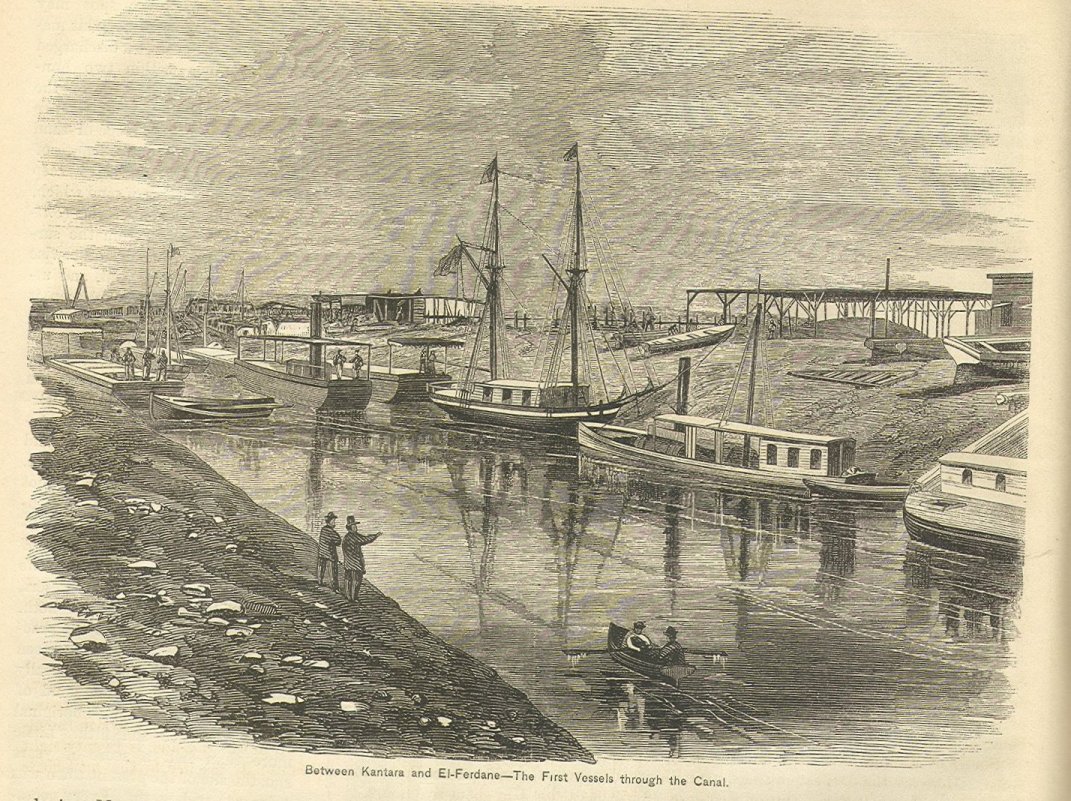 In the late eighteenth-century, Napoleon Bonaparte charged a survey team with the task of discovering the remnants of an ancient waterway that once joined the Mediterranean Sea and the Red Sea. Their findings appeared in the series of publications known as Description de l'Égypte published between 1809 and 1826. Although engineers deemed the route unsuitable for a new canal, the benefits of such a waterway inspired the French diplomat Ferdinand de Lesseps to secure a concession from the viceroy of Egypt, Said Pasha, to form a company construct a ship canal.
This authorisation, secured in 1854, granted a ninety-nine year lease on the land for the canal operators Compagnie Universelle du Canal Maritime de Suez ("The Suez Canal Company"), which incorporated in 1858. International scepticism resulted in most of the available shares being bought by French citizens. The Egyptian state purchased the remaining forty-four percent of the shares in the company in order that the project progress.
The construction began in 1859 employing tens of thousands of workers, most of whom were Egyptian forced labourers. Fearing a challenge to their domination of world trade, the British sent armed Bedouin to lead a revolt of the labourers. The viceroy condemned the use of slavery, halting work on the canal until the practice of involuntary labour ceased.
Following ten and a half years construction, on 17th November 1869 workers breached the barrage on the Suez plains reservoir filling the canal with water. Later that day the first ships sailed the 199 miles (192km) of canal joining the two seas. Ten days later the Egyptian Khedive, Ismail Pacha, officially opened the waterway.
Related posts
Entrance to the tomb of King Tutankhamun discovered: 4th November 1922
Golden Gate Bridge opened: 28th May 1937
10 November 2011
On this day in history: Stanley found Livingstone, 1871
 On 8th December 1840 Dr. David Livingston sailed from Britain to embark on missionary work in southern Africa. The month before he left he had received a medical licence from the Faculty of Physicians and Surgeons of Glasgow, and been ordained as a minister of the Congregational Union of England and Wales. In March 1841 he arrived in Cape Town where he stayed for a few weeks before heading north to take Christianity and western medicine to the Africans.
Over the next fifteen years he made several trips of exploration into the interior of the continent returning to Britain in 1856 to find that his accounts of his journeys had given him celebrity status. Over the next two years he wrote a book about his exploits entitled Missionary Travels and Researches in South Africa, and embarked on a speaking tour. In 1858 he became a member of the Royal Society and had an audience with Queen Victoria.
Later that year, he embarked on an expedition up the Zambezi and Shire rivers to assess the prospects for trade in that area. Livingstone's six and a half years spent in Africa proved expensive and less successful than expected. His team spent less than eighteen months actually exploring the interior as the project was dogged by illness and logistical nightmares. He returned home in 1864 to a much less rapturous welcome than before.
Livingstone set off on another expedition in 1865 to establish a trading outpost on Lake Tanganyika, to continue his missionary work, and to seek the source of the River Nile. His journey through south-west Africa proved difficult and dispiriting. Sickness ravaged his party, who also bore witness to the evidence of the work of slavers. Livingstone often had to take detours to avoid local conflicts and within a year he had lost contact with the outside world.
In October 1868, the publishing editor of the New York Herald, James Gordon Bennett, assigned the task of interviewing Livingstone to the journalist Henry Morton Stanley. Over the next three years Stanley travelled the world hoping to hear news of Livingstone to no avail. Finally, he decided to mount an expedition to find the missionary himself.
In March 1871, Stanley set off with a well-armed party numbering about two-hundred. The journey proved long and arduous with the expedition becoming embroiled in local wars and weakened by the ever-present diseases. Nevertheless, on (a date now thought to be) 10th November 1871, Stanley arrived at Ujiji on the shores of Lake Tanganyika where he doffed his cap and uttered the immortal phrase, ‘Dr. Livingstone, I presume?’ Stanley provided Livingstone's party with much needed supplies and stayed with them for four months.
The two men developed a close friendship while they explored the region, but Livingstone politely declined the offer of returning with Stanley. In 1872, Stanley returned to Britain to find himself the subject of controversy. Many people doubted his claim that he had found Livingstone. Nevertheless, his book in which he gave account of his expedition, How I Found Livingstone, sold well. Dr. Livingstone died in April 1873 from malaria and internal bleeding caused by dysentery.
Project Gutenberg hosts a number of works by and about Dr. David Livingstone, including The Last Journals of David Livingstone, in Central Africa, from 1865 to His Death, Vol. II, 1869-1873.
Related posts
Tanganyika and Zanzibar unite: 26th April 1964
4 November 2011
On this day in history: Entrance to the tomb of King Tutankhamun discovered, 1922
 In 1891, at the age of just seventeen, Howard Carter arrived in Egypt to work as an artist tracing the scenes on the walls of newly discovered tombs. While working for the passionate archaeologist W. M. Flinders Petrie at the excavation at el-Amarna, Carter first felt the inspiration to become an archaeologist himself. Nevertheless, he continued to work as an illustrator until 1899 when Gaston Maspero, the director-general of the antiquities service of Egypt, gave him the position of chief inspector of antiquities in Upper Egypt in recognition of his managerial skills.
The appointment surprised the archaeological community because Carter had no formal qualifications in the field; however, he proved a capable administrator working hard to preserve and protect existing antiquities, and overseeing new excavations. In 1904, Carter was transferred to lower Egypt but during the following year he resigned after a violent incident between a group of foreign visitors and Egyptian antiquities guards. After spending a couple of years barely supporting himself selling his watercolour paintings and working as a tourist guide, Carter formed a relationship with Lord Canarvon after being introduced to him by Maspero.
Canarvon provided the financial backing for a number of digs in Egypt, and before long Carter was supervising them all. Carter approached Canarvon for funding for a project of his own: the hunt for the tomb of Tutankhamun, a previously unknown pharaoh whose existence Carter had recently discovered. A number of years passed with little success and as a result the two agreed that the 1922 expedition would be the last.
On 4th November 1922 Carter located the steps leading down to Tutankhamun's tomb, the best preserved example of its type in the Valley of the Kings. The excavation work and removal of the artifacts took a decade to complete while Carter traveled the world presenting lectures that fueled a period of egyptomania. Ill health prevented Carter from producing a complete scientific report of his discovery, and he finally died aged 64 in 1939.
The Griffith Institute web-site hosts Howard Carter's records of the five seasons of excavations financed by Lord Carnarvon in the Valley of the Kings 1915 - 1922.
Related posts
Suez Canal opened: 17th November 1869
Lascaux cave paintings discovered: 12th September 1940
1 November 2011
On this day in history: First aerial bombing, 1911
 On 29th September 1911, the Italian government declared war on the Ottoman Empire having failed to achieve their demand for control of those Ottoman territories that make up modern day Libya. The conflict marked the first military use of airplanes. Initially the Italians used the new technology for reconnaissance, and later to attack Turkish troops.
On 1st November, Liuetenant Giulio Gavotti [pictured] set off on a reconnaissance flight over the Ain Zara oasis in his Taube ("dove") monoplane. He took with him four 2kg grenades with the intention of attacking the Turkish forces without the knowledge of his superiors. He dropped each of the bombs onto the enemy camp, but (thankfully) there were no casualties.
Related posts
Pink`s War began: 9th March 1925
First Zeppelin flight: 2nd July 1900
27 October 2011
On this day in history: Southern Rhodesians chose not to join the Union of South Africa, 1922
 In 1889, The British South Africa Company (BSAC) received a charter granting it the right to administer the territories between the Limpopo River and Lake Tanganyika in south-east Africa. The southern part of these territories was originally called South Zambezia, but in 1901 it became known as Southern Rhodesia - named after Cecil Rhodes, who founded the BSAC. By that time the colony was governed by the Southern Rhodesian Legislative Council, which initially consisted of four elected delegates and five nominees of the BSAC.
Over the years the Council grew, with increased democratic representation. The Council of 1920, included six BSAC nominees and thirteen elected members, the majority of which were part of the Responsible Government Association (RGA). The RGA wanted autonomous government for the colony within the British Empire, forming an alliance with the Labour Party to oppose one group which proposed that Southern Rhodesia become part of the Union of South Africa, and another group which wanted continued government by the BSAC.
The following year, a British Commission reported that the colony was prepared for responsible government, and that the electorate should decide whether Southern Rhodesia have their its own government or become part of the Union of South Africa. Even though the British government, the BSAC, and the South African government all favoured union, when the referendum was held on 27th October 1922, 59.4% of the votes supported responsible government, with a turnout of 78.5%. The following year, BSAC control of the colony ceased and in April 1924, the first elections were held for the Southern Rhodesian Legislative Assembly.
Related posts
First President of Senegal elected: 5th September 1960
Tanganyika and Zanzibar unite: 26th April 1964
Swaziland became independent: 6th September 1968
6 September 2011
On this day in history: Swaziland became independent, 1968
 Following the end of the Second Boer War (aka the Anglo-Boer War) in 1902, British troops entered the territories occupied by the Swazi people and attached it to the defeated Transvaal Colony as an imperial possession. Four years later, the British Government granted Transvaal limited self-government and set up a separate colonial administration for Swaziland. A resident commissioner governed the region according to orders issued by the British High Commissioner for South Africa.
When it came to making decrees High Commissioner consulted with the resident commissioner, the Swazi royal family and the European settlers. This latter group gained a degree of democratic representation in 1921, when the authorities established the European Advisory Council, who were mandated to advise the commissioner on non-Swazi affairs. In 1944, the British attempted to set up a puppet monarchy, giving the 'Paramount Chief' (as they called the king) authority over his people to make such decrees as he was told by the resident commissioner.
The lack of co-operation from King Sobhuza II, resulted in the British giving him unprecedented autonomy within their African possessions in 1952 and started preparing the Swazi people for independence. In the early 1960s political parties started to emerge in Swaziland, the most powerful of which was the Imbokodvo National Movement (INM) convened by the traditional Swazi leaders including the king. When elections for a legislative council were held in 1964, the INM won all twenty-four elective seats.
Following their election victory the INM adopted many of the more radical policies of the other parties they defeated, including a call for immediate independence. Following talks with the British government, the INM secured an agreement for Swaziland to become a constitutional monarchy with full independence being granted following parliamentary elections in 1967. Consequently, on 6th September 1968 Swaziland became an independent state.
The INM also won the first elections following independence in 1972. Nevertheless, a good showing by the Ngwane National Liberatory Congress, who received around 20% of the vote, resulted in the King Sobhuza dissolving parliament and repealing the 1968 constitution. Swaziland became an absolute monarchy until 1979 when he established a new parliament of elected representatives and his own appointees.
Related posts
Tunisian independence: 20th March 1956
Tanganyika and Zanzibar unite: 26th April 1964
First President of Senegal elected: 5th September 1960
Nelson Mandela released: 11th February 1990
5 September 2011
On this day in history: First President of Senegal elected, 1960
 Born in October 1906 at the coastal city of Joal, Léopold Sédar Senghor, started his formal education at a religious boarding school aged eight. In 1922 he entered a seminary in Dakar to become a clergyman, but it became clear that a religious career was not for him. He then completed his baccalaureate at a secular institution and received a scholarship to study literature in France.
In 1928 Senghor sailed for France. He studied at various institutions in Paris finally passed the Agrégation in French Grammar in 1935. Following graduation he became a schoolteacher in Tours and then on the outskirts of Paris. In 1939, Senghor enrolled as an officer in the French army but was captured by the Germans a year later, narrowly avoiding the death sentence meted out to other African prisoners.
He spent two years in prison camps, occupying himself writing poetry (for which he would later receive international acclaim), before the Germans released him on medical grounds. He resumed his teaching career and became involved with the resistance. After the war he became dean of the École Nationale de la France d'Outre-Mer, an institution for instructing colonial administrators.
Around this time Senghor became involved in politics. He was elected to the National Assembly as a deputy for Senegal-Mauritanie. In 1948, the radical socialist Mamadou Dia and the more moderate Senghor co-founded the Bloc Démocratique Sénégalais, which merged with other socialist parties to form the Bloc Populaire Sénégalais during the mid-50s.
In January 1959, Senegal and the French Sudan merged to form the ill-fated Mali Federation, which became fully independent from France in April 1960. Senghor was president of the Federation but he powerless to prevent it breaking up within months, due to political infighting. The French Sudan became the Republic of Mali, and the Republic of Senegal was formed.
On 5th August 1960, the Senegalese people went to the polls to elect their first President. The charismatic Senghor won the election, with Dia becoming Prime Minister. Two years later, Senghor sacked Dia for allegedly plotting to seize power in a coup, a charge he was found guilty of leading to his imprisonment for twelve years.
A rewritten constitution placed more power in the hands of the President, a position which Senghor held until 1980. In 1983, he became the first African to become a member of l'Académie française. Senghor died in December 2001, at Verson in Normandy where he spent his last years.
Related posts
Tunisian independence: 20th March 1956
Tanganyika and Zanzibar united: 26th April 1964
Swaziland became independent: 6th September 1968
Nelson Mandela released: 11th February 1990
27 August 2011
On this day in history: The shortest war in history, 1896
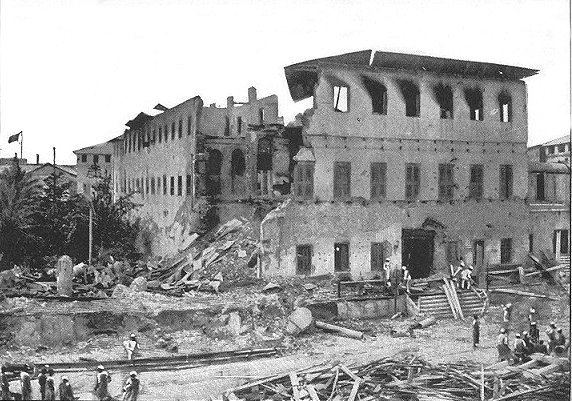 On the 27th August 1896 the shortest war in history was fought between the United Kingdom and Zanzibar. Three days earlier the pro-British Sultan Hamad bin Thuwain died, resulting in a power-struggle in which Hamad bin Thuwain's nephew Khalid bin Bargash took the reigns of power by force, as befitted the custom of the time. While he had widespread support of businessmen and landowners, Khalid did not have the support of the British who preferred a man they felt more amenable to their anti-slavery policy: Hamoud bin Mohamed, a nephew of the former Sultan of Oman.
After negotiations failed, the British issued an ultimatum to Sultan Khalid bin Bargash, demanding that he give up the throne. When the ultimatum passed on 9.00am, the British commander, General Lloyd Mathew, ordered the hastily assembled fleet of warships to start a bombardment of the royal palace and the Sultan's fleet. Forty minutes later the shelling stopped - the Zanzibarian navy was sunk, the palace was aflame, and the Sultan had fled to the German embassy. In all around five hundred Zanzibarians died in the war, with one British injury.
The following day, Hamud bin Muhammed was crowned Sultan, but was little more than a puppet of the British. Khalid bin Bargash went into hiding, until British troops captured him in Dar es Salaam in 1916. Soon released, he lived out the rest of his life in exile.
To read two very different accounts of the war see the BBC website page on 'The Anglo-Zanzibar War of 1896' and the 'Zanzibar Courage' page on the Zanzibar Unveiled site.
Related posts
British capture of Hong Kong: 23rd August 1839
Pink`s War began: 9th March 1925
Tanganyika and Zanzibar unite: 26th April 1964
14 June 2011
On this day in history: Ottomans conquered the Kingdom of Sennar, 1821
The Kingdom of Sennar was created at the dawn sixteenth-century when the Funj people led by Amara Dunqas conquered much of modern day Sudan. About twenty years later the Amara Dunqas converted from a fusion of Christianity and animism to Islam and took the title Sultan. Later that century Sennar reached its peak, having conquered many of its neighbours and posing a credible threat to Ethiopia to the south and Egypt to the north.
The seventeenth century was a period of slow decline for the Sultanate, as the monarch lost control of the economy, due to an influx of foreign currency, and the law, as Islamic legal scholars asserted their authority. Between 1769 and 1788 the Sultans were merely puppets of the Hamaj who following a successful revolt held the reigns of power as regents. As the sultans struggled to re-establish their rule and the regents fought to maintain their hold over the running of the country, the country became weakened and a target for the imperial ambitions of foreign powers.
In 1821, the army of general Ismail bin Muhammed Ali, son of the khedive of Ottoman Egypt, invaded Sennar. The forces of the Sultan, Badi VII, offered no resistance and on 14th June surrendered to Ismail, offering gifts and then having to watch the Ottoman troops loot his capital. Badi was restored as nominal rule of his lands, which were henceforth part of the Ottoman Empire.
Related posts
Shortest war in history: 27th August 1896
Fouad became King of Egypt: 15th March 1922
26 April 2011
On this day in history: Tanganyika and Zanzibar unite, 1964
On 26th April, 1964, the United Republic of Tanganyika and Zanzibar was born. In October of that year the country was renamed the United Republic of Tanzania (a portmanteau of Tanganyika and Zanzibar).
In December 1961, the East African state of Tanganyika achieved independence from the British, as a constitutional monarchy under a sultan, who was removed from power in June of the next year when the country became a republic. The British military had administered Tanganyika since the end of the First World War, before that it had been under the colonial control of the German East Africa Company. Prior to that, the Sultan of Oman ruled the area after he helped the indigenous population drive Portuguese colonists from the coast.
The Sultan of Oman also ruled the archipelago of Zanzibar from where he also forced the withdrawal of the Portuguese. In the nineteenth-century the islands became a British protectorate under the Sultan of Zanzibar. The British protection was part of their campaign against the slave trade, the islands' ports being an important to the trade. In December 1963, Britain granted Zanzibar full independence as a constitutional monarchy. Like Tanganyika, it became a republic, but only after a bloody revolution that cost thousands of lives.
See the U.S. Department of State's website for information about Tanzania, including the history of its constituent parts.
Related posts
Stanley found Livingstone: 8th December 1871
Shortest war in history: 27th August 1896
Swaziland becomes independent: 6th September 1968

 Posts