Born on 5th October 1713 in the city of Langres in eastern France, Diderot was destined for a life in one of the professions, initially as a clergyman and then as a lawyer. When he turned his back on a professional career to become a writer, his father disowned him. Diderot completed his rebellion by marrying below his station.
Diderot started out translating English texts into French before moving on to philosophical works and a collection of lewd stories. His work as a translator, counted in his favour when he received the commission for which he is most remembered, the Encyclopédie. The publisher of the Encyclopédie, Andre le Bréton, originally wanted a translation of Ephraim Chambers's Cyclopaedia of 1728, but after being swindled by the man he originally commissioned (an Englishman living in Paris called John Mills, who could neither write French, nor owned a copy of the Cyclopedia) he approached Diderot and Jean le Rond d'Alembert.
Diderot and d'Alembert took the work beyond its original remit, and used it to promote knowledge and undermine superstition. The 36 published volumes contained articles by the two editors as well as other luminaries of the enlightenment: Rousseau, Voltaire, Montesquieu, Quesnay. Many articles in the Encyclopédie excited controversy particularly those regarding religion in which the writers challenged Catholic dogma and praised Protestantism. In consequence the King Louis XV decreed that the entire work be banned in 1759, although the Encyclopédie continued to be produced through the support of powerful patrons, including the King's mistress, Madame de Pompadour.
Throughout his twenty-five year tenure as editor of the Encyclopédie, Diderot continued to write. He produced including works for and about the theatre in which he challenged the conventions of the day, as he did in his works of art criticism. In 1773, in order to furnish his daughter with a suitable dowry, he sold his library to Catherine the Great, consort of the Tsar of Russia, in whose court he spent some time before returning to France to spend the last decade of his life writing in relative obscurity.
Project Gutenberg has the text of John Morley's Diderot and the Encycloædists (1886), volume 1 and volume 2.
Related posts
Philosopher G.W.F. Hegel died: 14th November 1831
31 July 2011
On this day in history: Denis Diderot died, 1784


30 July 2011
On this day in history: Uruguay win first FIFA World Cup, 1930
 Founded in 1904, FIFA (Fédération Internationale de Football Association: 'International Federation of Association Football') soon fell into dispute with the International Olympic Committee about the sport's position in the Olympic games, particularly with regard to the issue of what constituted amateur status. When the organisers of the 1932 Los Angeles Olympics announced that soccer would not be part of the programme - due to the sport's lack of popularity in the United States - the FIFA president Jules Rimet decided to organise an international football competition. This competition took place in Uruguay, who were the current Olympic champions, in 1930, which was the bi-centenary of Uruguayan independence.
Thirteen national teams competed for the inaugural World Cup. Only four European teams travelled across the Atlantic to play the nine teams from the Americas. Initially, no European teams signed up, because their associations could not afford the expense of travel. In response, FIFA and the Uruguayans promised to cover the travel expenses of any European team. One notable absentee, the England team, failed to take part because the Football Association had withdrawn from FIFA three years before and declined a special invitation from the Uruguayan Football Association.
The competition format involved the division of teams into four groups. Each team played the others in their group once and the winners of each mini-league won a place in the semi-finals. In the semi-finals the winners of Group 1, Argentina beat the USA, winners of Group 4; the Group 3 winners and hosts Uruguay defeated Yugoslavia - strangely, the result of both games was 6:1.
On 30th July 1930, Uruguay faced their neighbours Argentina in the final at the Estadio Centenario, Montevideo in front of around 80,000 spectators. The hosts scored first, but Argentina responded with two goals to take a lead at half time. Three second-half goals for Uruguay sealed a 4:2 victory and they lifted the Jules Rimet Trophy for the first time.
Related posts
Foundation of first Irish football club: 20th September 1879
First black international footballer: 12th March 1881
First Italian football championship: 8th May 1898
First live radio broadcast of a soccer match: 22nd January 1927
29 July 2011
On this day in history: Italian King assassinated, 1900
 King Umberto I of Italy was born into the house of Savoy on 14th March 1844 and succeeded his father, Emmanuel II, in January 1878. Later that year the first attempt was made on Umberto's life when the anarchist Giovanni Passannante approached the king during a parade in Naples wielding a knife but Umberto warded off the attack with his sabre. The king commuted the resulting death sentence to one of penal servitude for the rest of Passannante's life.
This attack may have been part of a violent period of anarchist activity inspired by the tactic of 'propaganda by deed', which involved assassinations and bombings around the world. Umberto's conservatism and imperial ambitions made him a target, particularly following the Bava-Beccaris massacre of 1898.
This event was named after General Fiorenzo Bava-Beccaris, who ordered his troops to fire on a crowd demonstrating the rise in the price of bread in Milan. The volley of rifle and cannon fire killed between one- and four-hundred people, and injured up to one-thousand. Following the massacre, the king sent Bava-Beccaris a congratulatory telegram and later decorated him for his actions.
Across the Atlantic, an Italian immigrant living in Paterson, New Jersey, called Gaetano Bresci received news about the events in Milan. Bresci, a co-founder of the Italian language anarchist newspaper La Questione Social, decided to avenge the deaths of the demonstrators. In May 1900 he demanded the return of a loan from his comrades on the newspaper and, without a word of explanation, traveled back to his homeland to carry out the deed.
On the evening 28th July 1900, Umberto was attending a sporting event in Monza where he had a villa. While handing out prizes to winning athletes, the king was approached by Bresci who ran out of the crowd, drew his pistol, and fired three times. Umberto died from the wounds almost instantly. Following his trial, Bresci received a sentence of a life of hard-labour, but was found hanged in his cell less than a year later - the official verdict was suicide although many disputed this conclusion.
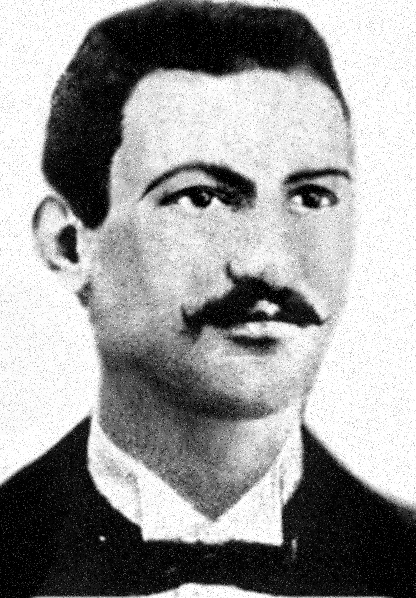 Gaetano Bresci
Related posts
Prince Murat executed: 13th October 1815
Wall Street Bombing: 16th September 1920

 Posts