 Born in 1603 in the Dutch province of Groningen, Abel Tasman entered the service of the Vereenigde Oost-Indische Compagnie (Dutch East India Company). By the mid-1630s Tasman was serving as a mate on a trading ship out of Batavia (modern day Jakarta). In 1634 he became master of the Mocha, a small trading ship, and served as second in command on a mission of exploration of the North Pacific.
After a series of journeys to various locations on the Pacific coast of Asia, Tasman commanded a fleet sent to search for the "Unknown Southland and Eastland" believed to be in the South Atlantic. In August 1642 he set sail for Mauritius where he turned south-east for then little known Australia. In November he sighted the island that now bears his name, which he claimed for the Netherlands on 3rd December.
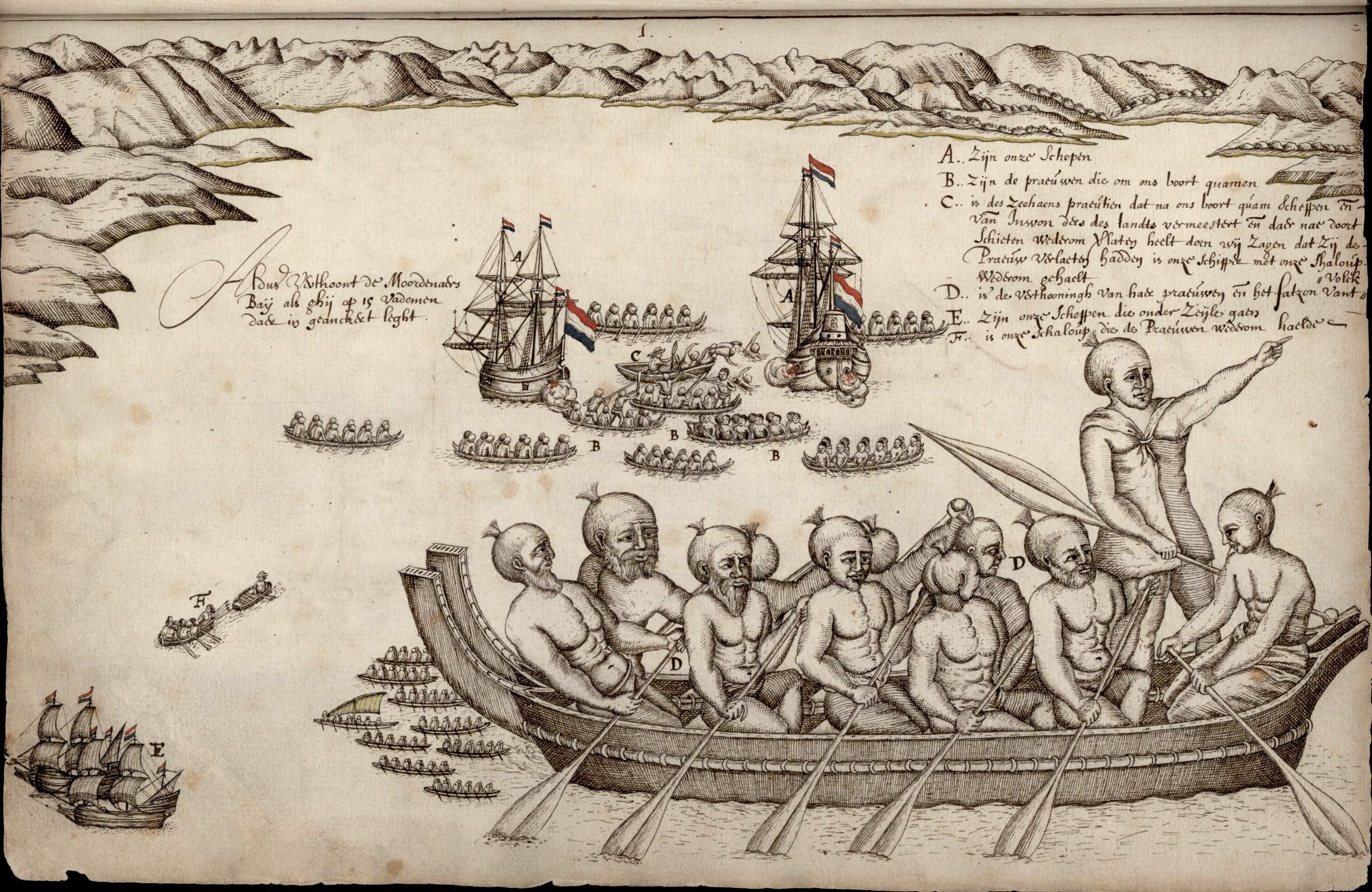
Tasman intended to turn north to explore the east coast of Australia, but strong winds took the fleet on an easterly heading. On 13th December the explorers sighted land: the north-west coast of the Southern Island of what is now known as New Zealand. While exploring the coast, the fleet had a number of encounters with the Maori including an attack on one of the Dutch ships, which goes some way to explaining why the fleet only made a brief landing on the 18th December.
The fleet continued to explore the islands before returning to Batavia via the Tongan and the Fiji islands. Tasman made another voyage of discovery in 1644 before becoming a senior official in Batavia. He continued to serve there until his death in October 1659, apart from a period of suspension as a result of him passing a death sentence on a man without trial.
Abel Janszoon Tasman's Journal of his Discovery of Van Diemen's Land and New Zealand in 1642 is available on the Project Gutenberg Australia site.
Related posts
First Europeans sight Tahiti: 18th June 1767
First expedition reaches the North Magnetic Pole: 1st June 1831
Kon Tiki expedition ended: 7th August 1947
18 December 2011
On this day in history: First European landing on New Zealand, 1642


19 September 2011
On this day in history: New Zealand women gained the right to vote, 1893
 During the nineteenth century women's suffrage movements emerged in democratic nations around the globe drawing upon the liberal philosophies of the Enlightenment. In New Zealand campaigners such as Kate Sheppard and Mary Ann argued that an extension of the franchise would increase the moral tone of politics and do more to protect the family, which was seen as the traditional sphere for women. These arguments persuaded a number of male politicians to support universal suffrage including John Hall, Robert Stout, Julius Vogel and William Fox - all of whom held office as Prime Minister of New Zealand.
In 1878, 1879, and 1887 the lower house of parliament passed amendments to electoral bills granting votes to women, but on each occasion the upper house, called the Legislative Council, blocked the amendment. In 1893 the Electoral Bill, which extended the franchise to all adult females (including Maori women), passed the House of Representatives. It would have been vetoed by the upper house as before had it not been for the heavy handed tactics of the Liberal Prime Minister, Richard Seddon.
Seddon opposed votes for women, but realising that a large proportion of his own party supported an extension of the franchise he decided to publicly support the Bill while applying pressure on members of the Legislative Council to veto it. In the opinion of two councillors, he applied a little too much pressure and they switched position in protest voting to support the measure, which the Council then passed by twenty votes to eighteen. On 19th September 1893, the Governor of New Zealand, Lord Glasgow, gave Royal Assent to the bill, and in November and December of that year, women voted for the first time in the national election.
The New Zealand History online site includes a number of pages dedicated to 'New Zealand women and the vote', including articles, a timeline and a gallery.
Related posts
First session of Finnish Parliament: 23rd May, 1907
The world`s first woman Prime Minister: 21st July, 1960
18 December 2010
On this day in history: First European landing on New Zealand, 1642
Born in 1603 in the Dutch province of Groningen, Abel Tasman entered the service of the Vereenigde Oost-Indische Compagnie (Dutch East India Company). By the mid-1630s Tasman was serving as a mate on a trading ship out of Batavia (modern day Jakarta). In 1634 he became master of the Mocha, a small trading ship, and served as second in command on a mission of exploration of the North Pacific.
After a series of journeys to various locations on the Pacific coast of Asia, Tasman commanded a fleet sent to search for the "Unknown Southland and Eastland" believed to be in the South Atlantic. In August 1642 he set sail for Mauritius where he turned south-east for then little known Australia. In November he sighted the island that now bears his name, which he claimed for the Netherlands on 3rd December.
Tasman intended to turn north to explore the east coast of Australia, but strong winds took the fleet on an easterly heading. On 13th December the explorers sighted land: the north-west coast of the Southern Island of what is now known as New Zealand. While exploring the coast, the fleet had a number of encounters with the Maori including an attack on one of the Dutch ships, which goes some way to explaining why the fleet only made a brief landing on the 18th December.
The fleet continued to explore the islands before returning to Batavia via the Tongan and the Fiji islands. Tasman made another voyage of discovery in 1644 before becoming a senior official in Batavia. He continued to serve there until his death in October 1659, apart from a period of suspension as a result of him passing a death sentence on a man without trial.
Abel Janszoon Tasman's Journal of his Discovery of Van Diemen's Land and New Zealand in 1642 is available on the Project Gutenberg Australia site.
Related posts
First Europeans sight Tahiti: 18th June 1767
First expedition reaches the North Magnetic Pole: 1st June 1831
Kon Tiki expedition ended: 7th August 1947
19 September 2010
On this day in history: New Zealand women gained the right to vote, 1893
During the nineteenth century women's suffrage movements emerged in democratic nations around the globe drawing upon the liberal philosophies of the Enlightenment. In New Zealand campaigners such as Kate Sheppard and Mary Ann argued that an extension of the franchise would increase the moral tone of politics and do more to protect the family, which was seen as the traditional sphere for women. These arguments persuaded a number of male politicians to support universal suffrage including John Hall, Robert Stout, Julius Vogel and William Fox - all of whom held office as Prime Minister of New Zealand.
In 1878, 1879, and 1887 the lower house of parliament passed amendments to electoral bills granting votes to women, but on each occasion the upper house, called the Legislative Council, blocked the amendment. In 1893 the Electoral Bill, which extended the franchise to all adult females (including Maori women), passed the House of Representatives. It would have been vetoed by the upper house as before had it not been for the heavy handed tactics of the Liberal Prime Minister, Richard Seddon.
Seddon opposed votes for women, but realising that a large proportion of his own party supported an extension of the franchise he decided to publicly support the Bill while applying pressure on members of the Legislative Council to veto it. In the opinion of two councillors, he applied a little too much pressure and they switched position in protest voting to support the measure, which the Council then passed by twenty votes to eighteen. On 19th September 1893, the Governor of New Zealand, Lord Glasgow, gave Royal Assent to the bill, and in November and December of that year, women voted for the first time in the national election.
The New Zealand History online site includes a number of pages dedicated to 'New Zealand women and the vote', including articles, a timeline and a gallery.
Related posts
First session of Finnish Parliament: 23rd May, 1907
The world`s first woman Prime Minister: 21st July, 1960
18 December 2009
On this day in history: First European landing on New Zealand, 1642
Born in 1603 in the Dutch province of Groningen, Abel Tasman entered the service of the Vereenigde Oost-Indische Compagnie (Dutch East India Company). By the mid-1630s Tasman was serving as a mate on a trading ship out of Batavia (modern day Jakarta). In 1634 he became master of the Mocha, a small trading ship, and served as second in command on a mission of exploration of the North Pacific.
After a series of journeys to various locations on the Pacific coast of Asia, Tasman commanded a fleet sent to search for the "Unknown Southland and Eastland" believed to be in the South Atlantic. In August 1642 he set sail for Mauritius where he turned south-east for then little known Australia. In November he sighted the island that now bears his name, which he claimed for the Netherlands on 3rd December.
Tasman intended to turn north to explore the east coast of Australia, but strong winds took the fleet on an easterly heading. On 13th December the explorers sighted land: the north-west coast of the Southern Island of what is now known as New Zealand. While exploring the coast, the fleet had a number of encounters with the Maori including an attack on one of the Dutch ships, which goes some way to explaining why the fleet only made a brief landing on the 18th December.
The fleet continued to explore the islands before returning to Batavia via the Tongan and the Fiji islands. Tasman made another voyage of discovery in 1644 before becoming a senior official in Batavia. He continued to serve there until his death in October 1659, apart from a period of suspension as a result of him passing a death sentence on a man without trial.
Abel Janszoon Tasman's Journal of his Discovery of Van Diemen's Land and New Zealand in 1642 is available on the Project Gutenberg Australia site.
Related posts
First Europeans sight Tahiti: 18th June 1767
First expedition reaches the North Magnetic Pole: 1st June 1831
Kon Tiki expedition ended: 7th August 1947
19 September 2009
On this day in history: New Zealand women gained the right to vote, 1893
During the nineteenth century women's suffrage movements emerged in democratic nations around the globe drawing upon the liberal philosophies of the Enlightenment. In New Zealand campaigners such as Kate Sheppard and Mary Ann argued that an extension of the franchise would increase the moral tone of politics and do more to protect the family, which was seen as the traditional sphere for women. These arguments persuaded a number of male politicians to support universal suffrage including John Hall, Robert Stout, Julius Vogel and William Fox - all of whom held office as Prime Minister of New Zealand.
In 1878, 1879, and 1887 the lower house of parliament passed amendments to electoral bills granting votes to women, but on each occasion the upper house, called the Legislative Council, blocked the amendment. In 1893 the Electoral Bill, which extended the franchise to all adult females (including Maori women), passed the House of Representatives. It would have been vetoed by the upper house as before had it not been for the heavy handed tactics of the Liberal Prime Minister, Richard Seddon.
Seddon opposed votes for women, but realising that a large proportion of his own party supported an extension of the franchise he decided to publicly support the Bill while applying pressure on members of the Legislative Council to veto it. In the opinion of two councillors, he applied a little too much pressure and they switched position in protest voting to support the measure, which the Council then passed by twenty votes to eighteen. On 19th September 1893, the Governor of New Zealand, Lord Glasgow, gave Royal Assent to the bill, and in November and December of that year, women voted for the first time in the national election.
The New Zealand History online site includes a number of pages dedicated to 'New Zealand women and the vote', including articles, a timeline and a gallery.
Related posts
First session of Finnish Parliament: 23rd May, 1907
The world`s first woman Prime Minister: 21st July, 1960

 Posts