In February, 1873 King Amadeo I abdicated from the Spanish throne. Three years earlier, following the revolution against Queen Isabella II, the Spanish parliament, the Cortes Generales, had elected Amadeo , an Italian prince, as King to reign as a constitutional monarch. Political infighting within the Cortes hampered his ability to respond to successive disasters: uprisings in support of the restoration of the Bourbon dynasty, known as Carlists; republican revolts; and even assassination attempts. Amadeo finally gave up and returned to Italy as the Duke of Aosta, after the increasingly radical government forced him to sign a decree to sack a group of artillery officers who had refused to take orders from their new commander.
The day after the abdication, the Cortes voted that Spain become a republic but could not agree on what form it should take, some preferred that Spain become a federation while others wanted a unitary republic. The divisions in Spanish society undermined the republic as they had done with the constitutional monarchy. In January, 1874 the Captain General of Madrid, Manuel Pavía, declared his opposition to the federalism, which resulted in the formation of a unitary government without the federalists and monarchists.
With the Cortes disbanded the fate of the nation rested in the hands of the military forces of the various factions. The republican army managed to reverse the territorial gains made by the Carlists before deciding not to oppose Brigadier Martínez Campos when he declared his support for the Bourbon Prince Alfonso, son of Isabella, on 29th December 1874. Having lost control of their armed forces the government of the first republic collapsed, paving the way for the restoration of the Bourbon monarchy.
29 December 2008
On this day in history: First Spanish Republic ended, 1874


20 December 2008
On this day in history: Electricity generated by nuclear power for the first time, 1951
 In 1934 the Italian physicist Enrico Fermi produced nuclear fission for the first time for which he received the Nobel Prize for Physics four years later. After receiving his prize, Fermi emigrated to the United States with his Jewish wife Laura to escape Mussolini's increasingly anti-semitic fascist regime in his homeland. He worked at Columbia University where he continued experimenting on nuclear fission before joining the project at the University of Chicago constructing the world's first nuclear reactor.
Following America's entry into the Second World War, the experimental work conducted on Chicago Pile-1 became part of the Manhattan Project, which was engaged in creating nuclear weapons. Following the end of the war, development began on more peaceful applications of reactor research, including the generation of electricity. To this end the United States government established the National Reactor Testing Station (NRTS) - now called the Idaho National Laboratory - in the Idaho desert in 1949.
That year construction work began on the Experimental Breeder Reactor 1 (EBR-1) at NRTS. Walter Zinn, who had also worked on the Manhattan Project, and his team at the Argonne National Laboratory designed EBR-1 as an attempt to prove that it was possible to create a breeder reactor rather than to become a working power plant. A breeder reactor is one that creates nuclear fuel at a rate that is greater than it can consume it.
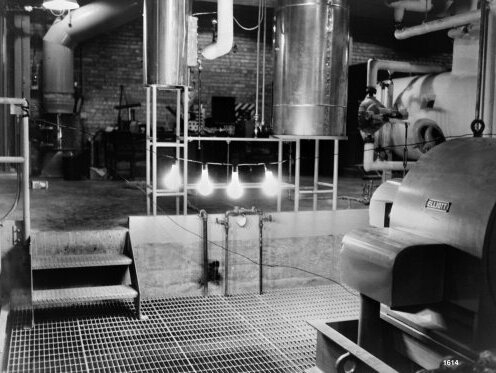
On 24th August 1951 the reactor went critical for the first time. At 1:50pm on 20th December 1951, the power station produced electricity for the first time. It generated enough electricity to illuminate four 200watt light bulbs. The next day the scientists repeated the experiment, producing enough electricity for the EBR-1 building.
Two years later, it successfully began producing fuel as a breeder reactor. Experiments continued on the EBR-1, even after the reactor suffered a partial meltdown in November 1955, until it was deactivated in 1964. The following year EBR-1 became a National Historic Landmark.
To learn more about the reactor see the Experimental Breeder Reactor 1 fact-sheet available as a pdf file from the Idaho National Laboratory site.
19 December 2008
On this day in history: Emily Brontë died, 1848
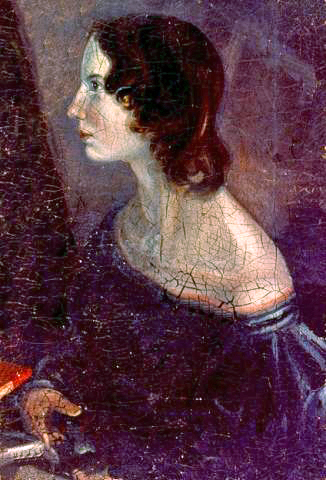 Born on 30th July 1818 at the Parsonage in Thornton, near Bradford, Yorkshire, Emily Jane Brontë was the fifth of six children of Revd. Patrick Brontë and his wife Maria. Nearly two years after her birth, Emily's family moved to the small industrial town of Haworth where her father had accepted the post of curate, which offered greater financial security. Unfortunately, a year and a half after the family relocated, Maria died.
Their mother's older sister Elizabeth Branwell stayed on with the family after nursing Maria during the last months of her life. While the older Brontë girls clashed with their aunt when she extolled the virtues of fastidiousness and self-discipline, Emily did not. As well as learning domestic skills the girls also received instruction in more academic subjects along with their brother Branwell.
The four oldest girls were sent to the Clergy Daughters' School at Cowan Bridge, a newly founded institution that provided a formal education to the daughters of less wealthy Anglican clergymen. The poor conditions at Cowan Bridge resulted in a number of pupils contracting illnesses, including Emily's oldest two sisters, Maria and Elizabeth, both of whom contracted tuberculosis, wcich caused their deaths in 1825. Revd. Brontë brought Emily and her sister Charlotte home where he and Miss Branwell continued to educate them.
The four remaining siblings became a close-knit group, developing imaginary worlds that they began writing about. The four were separated when Charlotte attended Roe Head school in Mirfield. She later returned as a teacher there accompanied by Emily who went there as a pupil. After only three months Emily became so ill that she had to return home to be replaced at Roe Head by her sister Anne.
Divided from her sister Anne, with whom she was closest, Emily became more self-reliant and remained apart from the rest of her family. Much of her time was spent secretly writing poetry until she took the position of teacher at Law Hill girl's school near Halifax in 1838. She remained there for six months before another illness required that she return to Haworth.
Charlotte had the idea of setting up a school and persuaded their aunt to pay for her and Emily to attend a school in Brussels. Emily struggled through nine months of being the oldest pupil in a school where lessons were taught in French - a language she was not well versed in - before her father summoned her and Charlotte home because of the death of their aunt.
In 1845, Charlotte discovered one of Emily's poetry books, much to the annoyance of the younger sister. In spite of Emily's anger, the other Brontë children persuaded her to allow them to select poems to be submitted for publication along with other poems written by her sisters. A year later two girls published the collection called Poems pseudonyms of Currer, Ellis, and Acton Bell (Charlotte, Emily and Anne respectively).
Two years later, Emily, again under the name Ellis Bell, published the work for which she became famous: Wuthering Heights. This epic tale of the Earnshaws of Wuthering Heights and the Lintons of Thrushcross Grange confounded the critics of the day because of its innovative style. The publishers demanded that Emily contribute towards the publishing costs, even though they were using the Bell name to cash in on the success of Jane Eyre, written by Charlotte under the name Currer Bell.
The following year, Emily's brother Branwell died of tuberculosis - the symptoms of which had been masked by his alcoholism. At his funeral Emily contracted a cold that resulted in her own death on 18th December 1848. Following her death, Charlotte edited the two part Wuthering Heights into a single volume that was published under her real name.
The Project Gutenberg site hosts Poems and Wuthering Heights as well as other works by the Brontës.

 Posts