Customised search for historical information

31 October 2011

On this day in history: Work finished on Mount Rushmore sculpture, 1941

During the early 1920s, the state historian of South Dakota, Doane Robinson, promoted his idea of commissioning giant sculptures of key figures in the history of the West, such as Chief Red Cloud, Lewis and Clark, and 'Buffalo' Bill Cody. For a while Robinson's ideas captured the public imagination resulting in many arguments for and against the plan, but the plans came to nothing until Robinson managed to enlist the support of the state's Senator, Peter Norbeck. Senator Norbeck enjoyed the sort of political influence that could move the project forward and he suggested that Robinson find a sculptor capable of undertaking the work.

In August 1924, Robinson contacted Gutzon Borglum who accepted the commission but did not wish to focus his attentions on local figures; rather, he wished to produce a work that was national in scope. After surveying possible sites, the sculptor chose Mount Rushmore in the Black Hills as the location and four key presidents as his subject matter. The presidents in question where George Washington, Abraham Lincoln, Thomas Jefferson and Theodore Roosevelt.

Senator Norbeck and the Congressman for South Dakota, William Williamson, arranged the passage of the required federal legislation to allow for the carving of the mountain. Following the passage of an equivalent Bill through the State legislature the work of raising funds could begin. Donations proved difficult to find until President Calvin Coolidge spent an extended vacation in the Black Hills, during which Borglum and Norbeck persuaded him to participate in the formal dedication of the work.

During his speech at the dedication ceremony, on 10th August 1927, President Coolidge pledged federal financial support for the project. After hearing the speech, Borglum climbed to the top of the cliff and made the first six drill holes. Over the next fourteen years, around four-hundred locals worked on-and-off to complete the project: constructing roads and infrastructure, dynamiting and then drilling, and sharpening thousands of drill bits.

A series of set-backs seriously reduced the scope of the project: the outbreak of the Second World War, Borglum's death from an embolism in March 1941, and the drying up of funds ended plans for a great vault behind the sculpture which was also scaled back. Borglum's son, Lincoln, continued his father's work until 31st October 1941. In all, the project cost slightly less than one million dollars and, surprisingly for a construction of that scale, it cost no lives.
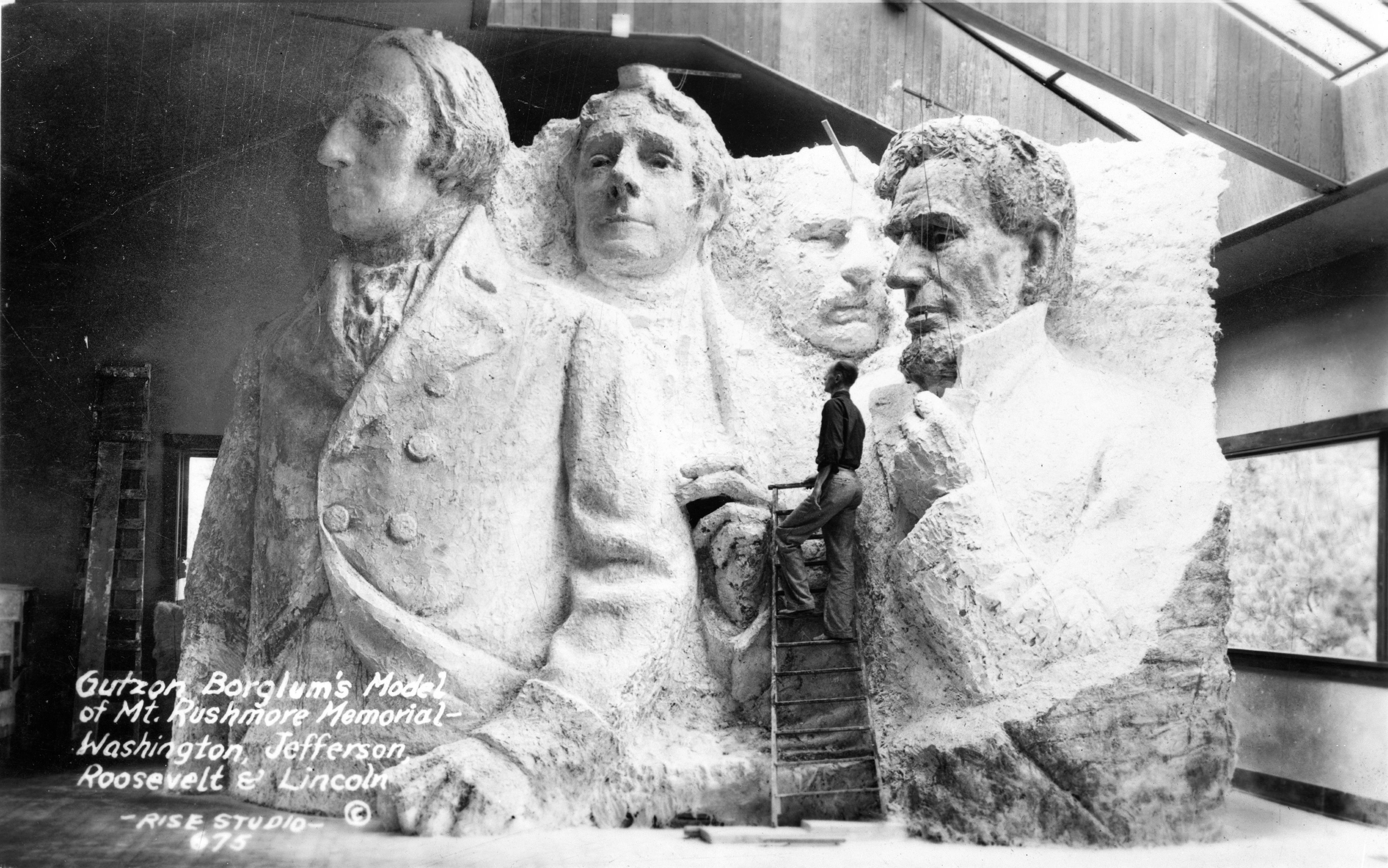
Borglum's scale model demonstrating the full scope of the project.

Related posts
Michelangelo began work on his sculpture of David: 13th September 1501
Lincoln Memorial dedicated: 30th May 1922

30 October 2011

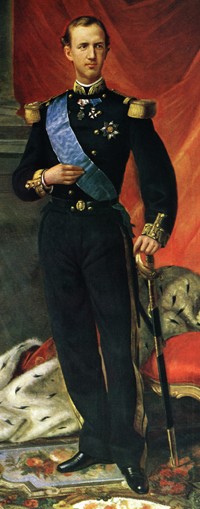
On this day in history: Coronation of George I, King of the Hellenes, 1863

In October 1862, following a power struggle that had lasted nearly two decades, King Otto of Greece lost his throne following a constitutionalist coup while he visited the Peloponnese. Ambassadors from the most powerful European countries persuaded Otto not to resist and he went into exile in Bavaria. The Greeks set up a regency council to rule, which called a national convention to decide the fate of the nation.

The Greeks rejected the heir presumptive, Otto's brother Leopold, as their new king with many preferring Alfred, Duke of Saxe-Coburg and Gotha. Alfred was son of Queen Victoria of Great Britain, who opposed his nomination along with the representatives of France, Great Britain and Russia at the London Conference of 1832, where they decided that no member of the Royal families of their three nations should rule in Greece. Nevertheless, the Greeks insisted on holding a plebiscite in which Alfred received 95% of the votes.

The plebiscite revealed that the vast majority of Greek people wanted to keep a monarchy, so a new candidate had to be found. Eventually, the foreign diplomats and Greek leadership decided upon the seventeen-year-old Prince Wilhelm of Denmark. Prince Christian Wilhelm Ferdinand Adolf Georg (as he was christened) was the second son of Prince Christian of Schleswig-Holstein-Sonderburg-Glücksburg (later King Christian IX of Denmark).

The Greek Assembly unanimously elected Prince Wilhelm as King George I. He received the title 'King of the Hellenes', as opposed to 'King of the Greeks', the title that Otto had held. Seven months later, on 30th October, George I arrived in Athens for his coronation.

During his early reign George was instrumental in bringing the debates about the constitution to a conclusion. While Greece became a constitutional monarchy in name, political instability often resulted in George imposing minority governments on the people, leading to accusations that he was engaged in absolutism. Nevertheless, his reign lasted for fifty years until his assassination at Thessaloniki in March 1913.

Related posts
Ivan the Terrible crowned Tsar, 16th January 1547
Scottish monarch crowned King of England: 25th July 1603
Coronation of William IV, 8th September 1831
First modern Olympiad: 6th April 1896

29 October 2011

On this day in history: Sir Walter Raleigh beheaded, 1618

Born in Devon in 1552 into a Protestant, Walter Raleigh served in Ireland during the suppression of the Desmond Rebellions between 1580 and 1581. He received forty-thousand acres of land seized from the Irish and became a major landlord in Munster. By this time Raleigh had embarked on a career at the royal court that resulted in him quickly becoming a favourite of Queen Elizabeth.

Following the death of half-brother, Humphrey Gilbert, Raleigh decided to continue Gilbert's plans for the New World. In 1585 (the year Raleigh received a knighthood) he received letters patent to set up colonies in North America and sent two expeditions across the Atlantic: the first to set up a base for privateering on Roanoke Island; and the second to establish a farming community. Both expedition ended in failure and Raleigh focused his energies on writing.

In 1591, Raleigh secretly married "Bess" Throckmorton, one of the queen's ladies-in-waiting, resulting in his disgrace. Elizabeth ordered Raleigh's imprisonment and expelled his wife from court. After his release he retired to his estate at Sherborne in Dorset and became a Member of Parliament, representing three different counties during his political career.

In 1595 he led a naval exploration of South America; took part in the capture of Cadiz, a year later; and, explored the Azores in the following year. By 1600, he had regained royal favour as demonstrated by her giving him the governorship of the Channel Island of Jersey. This restoration of his fortunes ended with the death of Elizabeth in March 1603.

Prior to the queen's death Raleigh had made an enemy of Sir Robert Cecil, who had been charged with a smooth transition to the new monarch, King James I, for whom he became a trusted advisor. Two months into his reign, James stripped Raleigh of his offices and monopolies. In July 1603 Raleigh was taken into custody and in November he faced trial for treason for being part of a plot against the new king.

Found to be guilty, he languished in the Tower of London until 1616, when he was released to embark on an expedition to Venezuela to find the legendary city of El Dorado. During the expedition, some of Raleigh's men sacked a Spanish outpost on the Orinoco river. The failure of the mission and the furious response of the Spanish gave James the excuse he needed to have Raleigh executed.

Following a number of failed attempts to escape and an investigation by a special commission, Raleigh faced the Privy Council where he was accused of treason and wishing to ferment war with Spain. The commissioners found him guilty and on 29th October 1618 Raleigh mounted the scaffold at Whitehall. After being shown the executioner's axe he remarked, "This is a sharp Medicine, but it is a Physician for all diseases and miseries."

Project Gutenberg hosts a copy of Raleigh's The Discovery of Guiana - an account of his 1595 expedition.

Related posts
First execution in Salem witch trials: 10th June 1692
Guillotine used for first time: 25th April 1792
Louis XVI executed: 21st January 1793
Prince Murat executed: 13th October 1815
Rosenbergs executed: 19th June 1953