


The appointment surprised the archaeological community because Carter had no formal qualifications in the field; however, he proved a capable administrator working hard to preserve and protect existing antiquities, and overseeing new excavations. In 1904, Carter was transferred to lower Egypt but during the following year he resigned following a violent incident between a group of foreign visitors and Egyptian antiquities guards. After spending a couple of years barely supporting himself selling his watercolour paintings and working as a tourist guide, Carter formed a relationship with Lord Canarvon after being introduced to Maspero.
Canarvon provided the financial backing for a number of digs in Egypt, and before long Carter was supervising them all. Carter approached Canarvon for funding for a project of his own: the hunt for the tomb of Tutankhamun, a previously unknown pharaoh whose existence Carter had recently discovered. A number of years passed with little success and as a result the two agreed that the 1922 expedition would be the last.
On 4th November 1922 Carter located the steps leading down to Tutankhamun's tomb, the best preserved example of its type in the Valley of the Kings. The excavation work and removal of the artifacts took a decade to complete while Carter travelled the world presenting lectures that fuelled a period of egyptomania. Ill health prevented Carter from producing a complete scientific report of his discovery; he finally died aged 64 in 1939.
The Ashmolean Museum web-site hosts Howard Carter's records of the five seasons of excavations financed by Lord Carnarvon in the Valley of the Kings 1915 - 1922.
4 November 2008
On this day in history: Entrance to the tomb of King Tutankhamun discovered, 1922


3 November 2008
On this day in history: Last hanging at Tyburn gallows, 1783
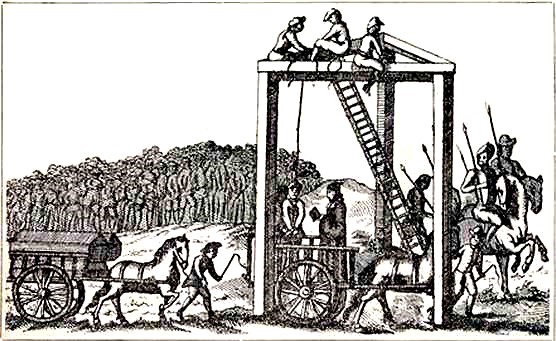
In 1571 the Elizabethan authorities constructed the "Tyburn Tree" a horizontal wooden triangle on three legs that enabled many people to be hanged at the same time. The religious strife of that period meant that many people were martyred at Tyburn including Edmund Campion, Robert Southwell and John Southworth, all of whom were later made saints by the Roman Catholic church. Later, following the restoration of King Charles II to the throne, the bodies of the regicides John Bradshaw, Oliver Cromwell, and Henry Ireton were exhumed and symbolically hanged in an act of grisly revenge.
On 3rd November 1783, the highwayman John Austin became the last person to be hanged at Tyburn. He was convicted of robbing and wounding 'a poor man' called John Spicer in a field near the road in Bethnal Green. Reportedly Austin's last words were "Good people, I request your prayers for the salvation of my departing soul; let my example teach you to shun the bad ways I have followed; keep good company, and mind the word of God." The sight of the "Tyburn Tree" is marked today by three brass triangles where Bayswater Road meets Edgware Road.
The transcript of the trial of John Austin is available on the Proceedings of the Old Bailey web-site.
2 November 2008
On this day in history: BBC Television Service started broadcasting, 1936
 The first television broadcast in Britain was made on 30th September 1929 using an electromechanical system pioneered by the Scottish inventor John Logie Baird. His Baird Television Development Company Ltd used the British Broadcasting Corporation's London transmitter to send images over the airwaves. The following year, with the introduction of the BBC's Brookmans Park twin transmitter, Baird was able to broadcast sound along with the pictures.
The BBC started their own experimental broadcasts in 1932, using Baird's thirty vertical line system. By 1936 Baird had improved his mechanical system to 240 lines; however, the BBC decided to alternate between it and Marconi-EMI's new completely electronic 405-line system for their regular broadcasts. So, on 2nd November 1936, the BBC television service started broadcasting for the first time from their new studios at Alexandra Palace using the Marconi-EMI system and the new VHF transmitter.
The 405-line broadcast was the first regular high-definition television service in the world. It proved so successful that after a few months of switching between the two systems on a weekly basis, the BBC stopped broadcasting using the Baird electromechanical system. While the official range of the broadcasts was twenty-five miles (40km), in practice they could be picked up much further away (on one occasion as far away as New York when RCA engineers were experimenting with a British TV-set).


 Posts
Posts


